
5 Supplier Checks Cafes Use to Find a Roaster Partner

Define your volume, service model, and quality bar first, then request roast-dated samples from two or three specialty roasters and compare them on consistency, sourcing transparency, training support, and cost-per-cup rather than price-per-pound. Ask your top pick for an operations checklist alongside the samples. The Specialty Coffee Association sets the training benchmarks worth checking, and roasters like specialty roasters build their wholesale programs around exactly these criteria.
TL;DR:
- Choosing a specialty roaster with roast-dated samples and sourcing transparency helps ensure consistency and ethical standards aligned with your business values.
- Focus on metrics like cost-per-cup, shot accuracy, and customer satisfaction signals, not just price-per-pound, to evaluate true value from suppliers.
- Specialty roasters provide better operational support and training, which can reduce waste and improve shot quality, offering better long-term margins.
- Conduct a 30 to 90 day trial with actual orders to assess supplier reliability, consistency, and team fit before committing to a long-term contract.
- Private-label programs and flexible equipment leases can add branding value and operational flexibility, but require careful review of terms and sourcing claims.
Table of Contents
- Clarify Your Business Needs Before You Choose a Wholesale Coffee Supplier
- What Types of Coffee Suppliers Should You Consider?
- Which Factors Actually Determine Supplier Quality?
- How Do You Compare Coffee Pricing Beyond the Per-Pound Rate?
- Contract Terms and Equipment Programs Worth Watching
- Operational Support That Protects Your Margins
- How Do You Run a Coffee Supplier Trial Before Committing?
- Why We Think of Roasters as Partners, Not Vendors
- Ready to See How Evening Roast Fits Your Bar?
- Sources
- FAQ
Clarify Your Business Needs Before You Choose a Wholesale Coffee Supplier
We’re going to say something that sounds obvious but trips up a lot of cafe owners: you can’t compare suppliers until you know what you’re actually running. An espresso-first cafe needs a roaster that nails consistency shot after shot. A grab-and-go counter cares more about drip and cold brew volume than latte art. A restaurant program might only need one solid house blend plus a decaf. Catering operations need suppliers who can handle irregular, spiky orders without blinking.
Start by estimating your weekly and monthly pounds, including your busiest week of the year, not your average one. That number determines whether a supplier’s minimum order quantities and delivery schedule will actually work for you.
Then set your own success metrics before you talk to anyone:
- A target cost-per-cup range for your menu
- How much shot-to-shot variation you’ll tolerate
- Customer satisfaction signals you already track, like repeat visits or complaint frequency
Walking into supplier conversations with these numbers changes the conversation entirely. You stop asking “what do you offer?” and start asking “does this fit what I already know I need?”
What Types of Coffee Suppliers Should You Consider?
Wholesale coffee distributors, importers, specialty roasters, and private-label programs all solve different problems, and mixing them up wastes time on both ends.
- Importers bring in green coffee at scale and mainly serve large roasters, not cafés directly.
- Distributors carry multiple roasted brands and prioritize logistics and breadth over a single roaster’s craft.
- Specialty roasters roast in smaller batches, publish origin details, and often provide equipment and training support.
- Private-label programs let you sell a roaster’s coffee under your own brand for retail bags or subscription boxes.
A single-shop specialty cafe generally does best with a dedicated specialty roaster who knows their name at the roastery. A multi-location operation might need a distributor for reach, paired with a specialty roaster for the flagship blend. Private-label makes sense once you have loyal customers who’d buy your branded bag to take home, something worth exploring through coffee bag and packaging programs built specifically for that purpose.
Which Factors Actually Determine Supplier Quality?
Five things separate a reliable coffee partner from a vendor you’ll be replacing in a year. Score each candidate against these before you sign anything.
- Quality signals. Ask for the roast date on every bag, not just a “best by” stamp. A specialty roaster typically publishes roast date, origin, and processing method as a baseline, not a premium feature. Request tasting notes and confirm whether a blend’s flavor profile holds steady batch to batch, since single-origin coffees shift more with harvest seasons than a well-managed blend.
- Sourcing and ethics. Roasters serious about origin transparency can tell you the farm or cooperative, not just the country. Organic and B Corp status are verifiable, unlike vague “direct trade” language with no paperwork behind it. Our guide to coffee certifications breaks down what each label actually guarantees.
- Operational support. Ask who handles equipment, and how fast they respond when a grinder jams during your Saturday rush.
- Training. Look for SCA-trained staff or a licensed Q Grader on the roasting team, and ask whether onboarding is a single visit or ongoing coaching.
- Commercial terms. Get clarity on minimum order quantities, lead times, and how often prices can move.
Pro Tip: Ask every candidate the same five questions in the same order, and score their answers on a simple 1 to 5 scale. It sounds tedious, but it’s the only way to compare apples to apples once you’re three conversations deep and they all start blurring together.
How Do You Compare Coffee Pricing Beyond the Per-Pound Rate?
Price-per-pound is the least useful number on a supplier’s price sheet, because it hides what actually hits your bottom line: cost-per-cup. A $14 per pound espresso bag yields roughly 22 to 25 double shots per pound at an 18 to 20 gram dose, which works out to about $0.56 to $0.63 in coffee cost per beverage. A $12 bag that pulls inconsistent shots and forces more dose adjustments can end up costing you more per cup once you factor in waste.
Before comparing quotes, account for the costs that don’t show up on the price sheet:
- Freight and delivery minimums that push you toward bigger, less fresh orders
- Storage space and bean shelf life if you’re buying beyond a few weeks of use
- Equipment financing baked into a “bundled” per-pound rate
- Waste from inconsistent extraction or training gaps
Pricing structures vary too. Some suppliers offer tiered volume discounts, others run flat subscription pricing, and private-label programs typically carry a premium over house-blend wholesale rates.
Contract Terms and Equipment Programs Worth Watching
Read the fine print before you read the roast date. Contracts typically cover length, minimum order quantities, a price adjustment formula tied to green coffee costs, termination rights, and sometimes exclusivity clauses that lock you into one supplier for espresso, drip, or both.

Equipment leasing is common in this business, and lease terms for high-end espresso machines and grinders typically run 12 to 36 months. A longer lease usually means a lower monthly payment, but it also means less flexibility if the partnership doesn’t work out. Month-to-month or shorter pilot terms cost more per month but let you walk away without penalty.
Watch for these red flags:
- Vague sourcing language with no farm, cooperative, or region named
- No stated roast-date policy on delivered bags
- Steep early-termination penalties buried in an exclusivity clause
- Equipment “included free” language that hides a multi-year lock-in
Operational Support That Protects Your Margins
Good suppliers don’t just drop off bags. A strong wholesale partner provides onboarding training, covering calibration, extraction recipes, and daily workflow checklists, ideally with an in-person trainer visit rather than a PDF and a phone number. Our barista guide to cafe-quality extraction covers the fundamentals your team should have down cold.
On the equipment side, ask about preventive maintenance schedules, emergency repair turnaround, and water treatment guidance, since water quality quietly ruins more shots than bad beans do.
- Track consistency (shot times, taste tests) before and after onboarding
- Measure waste reduction over the first 60 days
- Watch customer satisfaction signals for a training ROI you can actually see
Pro Tip: If a supplier can’t tell you their preventive maintenance schedule off the top of their head, that’s a preview of how they’ll handle your 6 AM emergency when the grinder dies.
How Do You Run a Coffee Supplier Trial Before Committing?
A structured trial beats gut instinct every time, and it only takes 30 to 90 days to get real data.
- Request roast-dated samples from two or three candidates and run a blind cupping with your team, scoring aroma, acidity, body, and finish.
- Design a 30 to 90 day pilot with a small order, using your actual bar setup and staff, not a demo booth.
- Track KPIs during the pilot: consistency across shifts, real cost-per-cup, and direct customer feedback from regulars who’ll tell you if something tastes off.
- Debrief and negotiate using pilot data as leverage, locking in price adjustment terms and lease length before signing anything longer than a year.
Why We Think of Roasters as Partners, Not Vendors
The cheapest bag rarely stays cheap once you count waste, retraining, and the hours spent troubleshooting an unreliable delivery schedule. A roaster who shows up for equipment support and training earns back their price difference fast, usually within the first few months of fewer bad shots and less staff frustration.
That’s the standard The Flaming Bean holds itself to with its wholesale program, and it’s the standard we’d point any cafe owner toward, regardless of who they choose. Weigh values and fit as heavily as you weigh the price sheet.
— Tony
Ready to See How Evening Roast Fits Your Bar?
Some wholesale programs are built around a similar checklist: roast-date transparency on every bag, structured training support for baristas, and private-label options for businesses ready to put their own name on the bag. Every wholesale account gets access to real batch and origin details, not marketing copy dressed up as sourcing information.
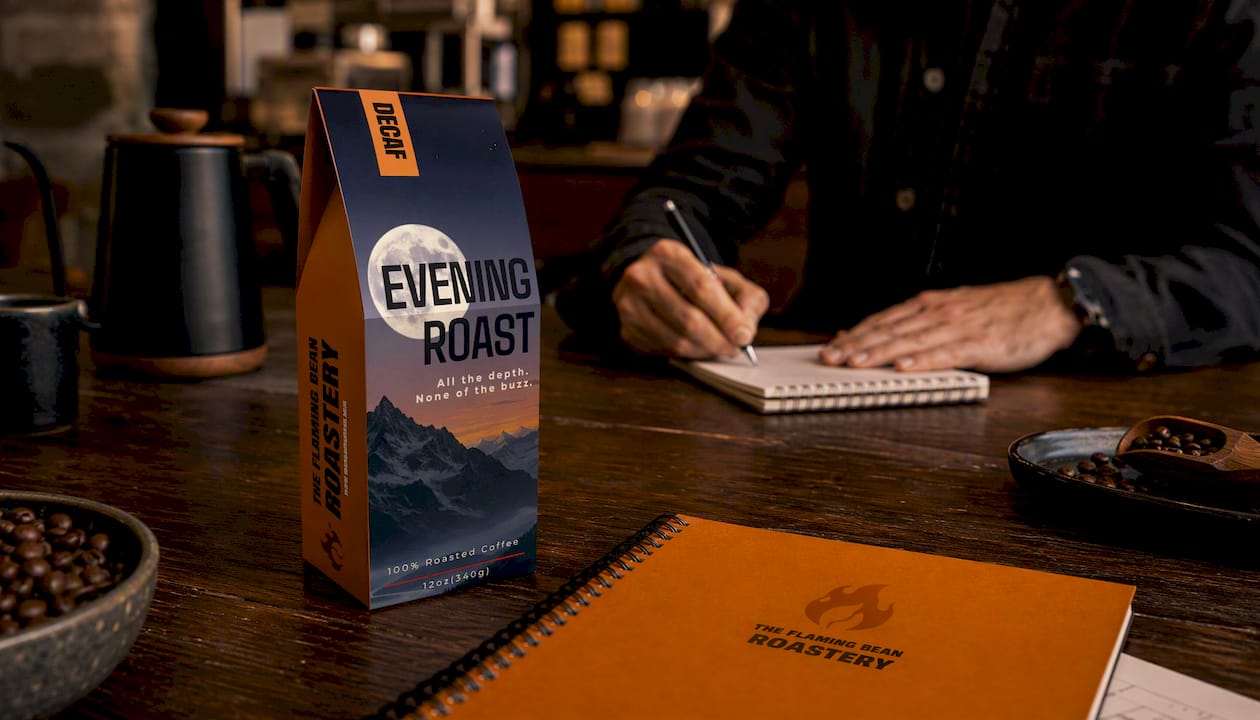
Evening Roast is a good starting point for cafes that want a smooth, approachable house blend that works across espresso and drip without asking your team to relearn dosing. Check out the Evening Roast product page for tasting notes and details, and if you serve a takeaway-heavy menu, this food service quality guide is worth a read alongside it. Request a sample or start a wholesale conversation with The Flaming Bean today, and see how the numbers stack up against what you’re currently paying.
Sources
- Understanding supplier partnerships for coffee shops — Perfect Daily Grind
- The complete guide to choosing a wholesale coffee roaster for your cafe — Higher Grounds Trading (blog)
- Specialty roaster guide — BrewFYI
FAQ
How do I get wholesale coffee for my cafe?
Contact specialty roasters or distributors directly, ask about their wholesale program, request roast-dated samples, and confirm minimum order quantities before signing a contract.
What is the 15-15-15 rule for coffee?
There’s no single agreed-upon industry definition of a “15-15-15 rule” for coffee, so treat any source that states one as a rule of thumb rather than an established standard.
What is the 80/20 rule for coffee?
It’s commonly used to describe the idea that roughly 80% of a cafe’s sales come from around 20% of its menu items, which is why nailing your core espresso and drip offerings matters more than chasing an expansive menu.
What is the cheapest coffee to buy in bulk?
Commodity-grade robusta and lower-grade arabica blends from large distributors tend to carry the lowest per-pound price, but they typically sacrifice the consistency and origin transparency that specialty cafes rely on for repeat business.
Comments