
Coffee Certification Explained: A Complete 2026 Guide

Coffee certification is the process by which independent bodies verify that coffee producers meet specific environmental, social, and economic standards throughout the supply chain. These certifications, covering programs like USDA Organic, Fair Trade, Rainforest Alliance, and Bird Friendly, give consumers and buyers documented proof of how their coffee was grown, traded, and processed. For anyone serious about coffee culture and sustainability, understanding what these labels actually mean, and what they don’t, changes how you shop and how you think about every cup. This guide covers the coffee certification explained from label to farm, with real costs, timelines, and honest trade-offs.
What is coffee certification and why does it matter?
Coffee certification is a formal third-party verification system. A farm, cooperative, or processor applies to a certifying body, undergoes an audit, and receives a seal if it meets the program’s standards. That seal then appears on packaging, signaling compliance to buyers and consumers.
The stakes are real. Certification connects farmers to premium markets, protects ecosystems, and gives consumers a way to verify claims that would otherwise be impossible to check from a grocery store aisle. Without independent verification, terms like “sustainable” or “ethically sourced” are marketing language with no accountability behind them.
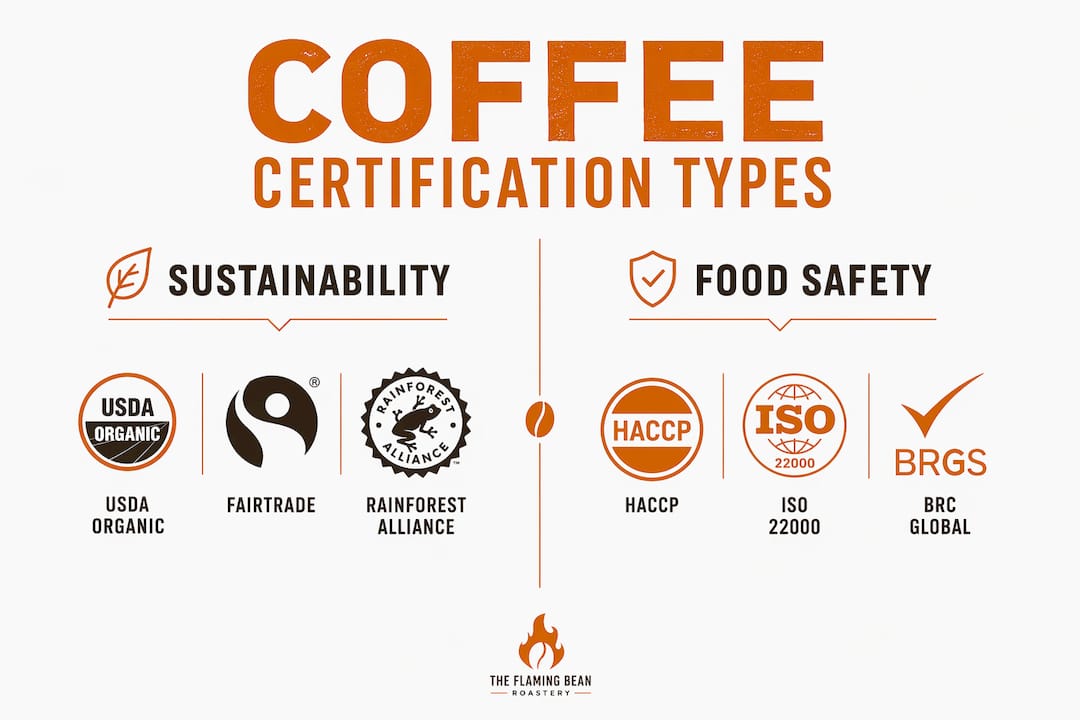
Three named entities dominate the conversation: the USDA National Organic Program, Fairtrade International, and the Rainforest Alliance. Each covers different ground. USDA Organic focuses on farming inputs and soil health. Fairtrade International centers on labor rights and minimum pricing. Rainforest Alliance addresses environmental management, social responsibility, and farm operations together. Knowing the difference is the starting point for reading any coffee label with confidence.
What are the main types of coffee certifications?
The coffee certification process is not one-size-fits-all. Each program sets its own standards, covers different parts of the supply chain, and appeals to different buyers.
| Certification | Primary Focus | Key Requirements | Typical Buyer |
|---|---|---|---|
| USDA Organic | Farming inputs | No synthetic pesticides or GMOs, multi-year soil transition | Retail consumers |
| Fair Trade | Labor and pricing | Minimum floor price, community premiums | Ethical shoppers |
| Rainforest Alliance | Environment and farm management | Deforestation ban, wastewater management, traceable land use | Retail and foodservice |
| Bird Friendly | Ecological habitat | Organic baseline plus multilayer canopy, 40% shade coverage | Specialty buyers |
| 4C (Common Code) | Baseline sustainability | Entry-level social, environmental, and economic criteria | Commodity buyers |
| B Corp | Whole business | Governance, workers, community, environment, customers | Mission-driven brands |
USDA Organic certification prohibits synthetic pesticides and genetically modified organisms, requiring a multi-year transition with documented soil health practices. That transition period, typically three years, is one reason organic coffee commands a price premium.
Bird Friendly certification stands out as one of the most ecologically demanding programs available. It requires at least 10 native tree species, three canopy layers, 40% shade coverage, and canopy height above 12 meters, all on top of an organic baseline. Very few farms worldwide hold this seal, which makes it a reliable signal of genuine ecological commitment.
Many farms pursue dual certifications. A farm might hold both USDA Organic and Rainforest Alliance seals because each opens different market channels. Organic attracts health-focused retail buyers. Rainforest Alliance satisfies foodservice contracts with companies like Nespresso and Starbucks. Stacking certifications increases administrative burden but also increases market access.
How does the coffee certification process work?
Getting certified is a structured journey. The steps are consistent across most programs, though timelines and costs vary significantly.
- Registration and application. The farm or cooperative submits an application to the certifying body, pays an initial fee, and receives a self-assessment checklist.
- Self-assessment and gap analysis. The applicant reviews current practices against the certification standard and identifies areas that need correction before the audit.
- Third-party audit. An accredited inspector visits the farm, reviews documentation, interviews workers, and assesses field conditions.
- Corrective action period. If the auditor finds non-conformances, the farm must address them within a set window. Rainforest Alliance certification includes 6–16 weeks for corrective actions after the initial audit.
- Certification decision. The certifying body reviews the audit report and corrective actions, then issues or denies the certificate.
- Annual renewal. Most certifications require annual audits or surveillance visits and renewal fees to maintain the seal.
The full timeline from registration to certificate typically runs 4–8 months. Rainforest Alliance alone includes 1–2 weeks for registration, then the corrective action window, then 2–6 weeks for post-audit review.
Certification costs vary by standard and farm size. Initial costs run $700–$1,500 for USDA Organic and $1,000–$2,000 for Rainforest Alliance. Annual renewal fees range from $400–$700 for Organic, $500–$1,500 for Rainforest Alliance, and $1,000–$3,000 for Fair Trade. For a smallholder farming two or three hectares, those numbers represent a significant share of annual income.
Pro Tip: If you are a small producer, joining a certified cooperative is the fastest and most affordable path to market access. Cooperatives pool audit costs and share compliance documentation, cutting individual expenses dramatically.
Many small farms remain uncertified precisely because documentation requirements, batch tracking, and input logs create an administrative burden that individual farmers cannot manage alone. Cooperatives exist partly to solve this problem, but not every region has accessible cooperative infrastructure.
What are the real benefits and limitations of coffee certifications?
Certifications deliver measurable benefits, but they also carry real limitations that every coffee buyer should understand.
Economic benefits:
- Fair Trade sets a floor price of $1.40 per pound for Arabica coffee, plus community development premiums paid directly to cooperatives. That floor protects farmers when global commodity prices drop below production costs.
- USDA Organic coffee commands a market premium of 25–30% over conventional coffee. That premium reflects both the cost of compliance and the market demand for chemical-free production.
- Rainforest Alliance certification opens doors to major foodservice contracts that require documented sustainability credentials.
Social and environmental benefits:
- Fair Trade premiums fund schools, health clinics, and infrastructure in farming communities.
- Rainforest Alliance standards require documented wastewater management, a prohibition on deforestation, and traceable land use history. These rules protect watersheds and biodiversity in coffee-growing regions.
- Bird Friendly farms function as wildlife corridors, supporting migratory bird populations across Central and South America.
Limitations buyers should know:
- Certification does not guarantee cup quality. A certified coffee can still be mediocre. Quality depends on variety, processing, roasting, and brewing, none of which certifications control.
- The cost and paperwork burden excludes many excellent small farms that practice sustainable agriculture without formal verification.
- Some certifications use “mass balance” accounting, meaning a percentage of uncertified coffee can move through a certified supply chain without losing the label. This affects how literally you should read certain seals.
- Certification audits happen annually or less frequently. Conditions on the ground can change between visits.
The most informed buyers look for multiple certifications combined with roaster transparency. A roaster that publishes farm names, harvest years, and processing methods alongside certification seals gives you far more information than a seal alone.
How do food safety certifications differ from sustainability labels?
Two certification types operate almost invisibly to retail consumers but matter enormously in the B2B coffee trade: HACCP (Hazard Analysis and Critical Control Points) and ISO 22000.
| Certification | Focus | Who Requires It | What It Covers |
|---|---|---|---|
| HACCP | Food safety hazard control | Wholesale buyers, importers | Biological, chemical, and physical hazard prevention |
| ISO 22000 | Food safety management system | Enterprise buyers, retailers | Full supply chain food safety management |
| USDA Organic | Farming inputs | Retail consumers | Growing practices, no synthetics |
| Fair Trade | Labor and pricing | Ethical retail buyers | Minimum prices, labor standards |
Food safety certifications like HACCP and ISO 22000 are more critical for B2B coffee exporters than consumer-facing sustainability labels. These certifications signal supply chain maturity and risk mitigation that enterprise buyers require for contracts worth $50,000 or more.
A coffee exporter without HACCP documentation will struggle to win contracts with major importers, regardless of how many sustainability seals the farm holds. HACCP proves that the processing facility controls contamination risks at every critical point. ISO 22000 extends that logic across the entire food safety management system, from farm gate to export container.
For wholesale buyers evaluating suppliers, food safety certifications reduce liability and satisfy regulatory requirements in markets like the European Union and the United States. Sustainability labels matter for brand positioning. Food safety certifications matter for legal compliance and contract eligibility.
How should you read coffee certification labels?
Reading a certification label critically takes about 30 seconds once you know what to look for.
First, check whether the certification body is named on the packaging. A genuine Rainforest Alliance seal includes the frog logo and a certification code you can verify on the Rainforest Alliance public database. Fair Trade USA and Fairtrade International are separate organizations with different standards, so the specific logo matters.
Second, understand mass balance rules. Rainforest Alliance’s mass balance system permits a defined percentage of uncertified coffee to move through a certified supply chain before the label claim is lost. A bag labeled “Rainforest Alliance Certified” may contain a blend where not every bean meets the full standard. This is legal and disclosed in the certification framework, but it means the label is a signal of direction, not a guarantee of 100% certified content.
Third, look for producer or cooperative information. Roasters who name the farm, the region, and the harvest year are giving you traceability that goes beyond what any certification seal provides. That transparency is the strongest signal of genuine sourcing integrity.
Pro Tip: Search the certifying body’s public database using the code printed on the bag. Rainforest Alliance, Fair Trade USA, and USDA Organic all maintain searchable registries. If the code doesn’t appear, the certification claim deserves scrutiny.
Certifications tell you how coffee was grown and traded. They don’t tell you how it tastes. Combine label reading with roaster reputation and you have a complete picture.
Key takeaways
Coffee certification is a verified compliance system, not a marketing claim, and understanding the differences between USDA Organic, Fair Trade, Rainforest Alliance, and food safety standards like HACCP gives you real purchasing power.
| Point | Details |
|---|---|
| Certifications verify, not guarantee | Each seal confirms compliance with specific standards, not overall coffee quality or flavor. |
| Costs are significant for small farms | Initial fees run $700–$2,000 depending on the program, pushing many smallholders toward cooperatives. |
| Food safety certs serve B2B buyers | HACCP and ISO 22000 are required for major wholesale contracts, not consumer retail shelves. |
| Mass balance affects label claims | Some certified bags contain a percentage of uncertified coffee, which is legal but worth knowing. |
| Transparency beats labels alone | Roasters who publish farm names and harvest years give more information than any single certification seal. |
What i’ve learned about certifications after years in coffee culture
The gap between the seal and the story
I’ve spent years reading certification documents, visiting roasters, and talking to people who work directly with farming cooperatives. My honest observation is this: certifications are a floor, not a ceiling.
The best coffee I’ve encountered often comes from farms that hold multiple certifications and still go further. They publish harvest data. They share processing notes. They name their farmers. The certification seal got them in the door with buyers. The transparency kept those relationships alive.
What concerns me is the consumer assumption that one seal equals one complete story. Fair Trade is not the same as Organic. Rainforest Alliance is not the same as Bird Friendly. Each covers a different slice of a complex supply chain, and treating them as interchangeable flattens a genuinely important distinction.
The barrier for small farmers is also something the industry doesn’t talk about enough. Certification costs and administrative burdens frequently require smaller farms to join cooperatives just to afford compliance. That’s a structural problem. Some of the most carefully farmed, most ecologically sound coffee in the world never gets certified because the farmer can’t afford the paperwork. That coffee doesn’t disappear. It just gets sold without a seal, often at lower prices, to buyers who don’t ask questions.
My prediction for the next few years: direct trade relationships and digital traceability tools will start to supplement, and in some cases replace, traditional certification seals for specialty buyers. That shift won’t eliminate certifications. It will make them one data point among many rather than the final word.
— Tony
Explore certified and purposeful coffee at the flaming bean
At The Flaming Bean, we care about what’s in your cup and where it came from. We source exceptional coffees with an eye toward responsible, traceable origins, and we roast each one to bring out the character the farm worked hard to create.
If you want to start with something smooth and approachable, our Evening Roast is a great place to begin. For those who want their coffee to do more, our Safe Ground blend supports organizations protecting vulnerable communities. We also offer wholesale options for buyers who want responsibly sourced coffee at scale. Every cup from The Flaming Bean is a small vote for the kind of coffee industry worth supporting.
FAQ
What does coffee certification mean?
Coffee certification is a third-party verification process confirming that a farm or supply chain meets specific environmental, social, or economic standards. Common programs include USDA Organic, Fair Trade, and Rainforest Alliance.
How long does it take to get coffee certified?
The full certification process typically takes 4–8 months, covering registration, audits, corrective actions, and final review. Rainforest Alliance alone requires 6–16 weeks for corrective actions after the initial audit.
Does certification guarantee better-tasting coffee?
No. Certifications verify farming and trading practices, not cup quality. Flavor depends on variety, processing, roasting, and brewing, none of which certification programs control.
What is the difference between fair trade and organic coffee?
Fair Trade focuses on labor rights and sets a minimum floor price of $1.40 per pound for Arabica. USDA Organic focuses on farming inputs, prohibiting synthetic pesticides and GMOs. A coffee can hold one, both, or neither certification.
Why do some sustainable farms lack certification?
Many small farms remain uncertified because initial costs, documentation requirements, and audit complexity create barriers that individual farmers cannot manage alone. Joining a cooperative is the most common solution for cost-sharing.
Comments