
Coffee Fulfillment Services Explained: Order to Doorstep

Coffee fulfillment services explained simply: a roastery captures your order, schedules it into a roast batch, runs quality checks, packages it, and ships it, typically within 48 hours of roasting for subscriptions. That timeline touches everyone who buys from The Flaming Bean, whether you’re grabbing a single bag, running a subscription, or managing a wholesale or private-label account.
Here’s who handles what:
- Sales and the ordering portal capture your order and route it to production
- The roasting team turns queued orders into scheduled batches
- Quality control cups and verifies every batch before it’s cleared
- Fulfillment staff pick, pack, and double-check each shipment
- Carriers move it the last mile with tracking attached
The fastest path applies to subscription and retail orders, usually shipped within 48 hours of roasting. Wholesale orders are scheduled on a regular weekly cadence. Private-label work takes longer due to sample approval and specification sign-off processes.
Key Takeaways
Coffee fulfillment works because order capture, roast scheduling, quality control, and shipping are treated as one connected system rather than separate departments.
| Point | Details |
|---|---|
| Freshness has a clock | Subscription orders should ship within 48 hours of roasting to avoid stale bags. |
| Traceability builds trust | Roast dates and batch codes let you verify what you’re actually drinking. |
| Wholesale needs structure | Online ordering portals and defined cutoffs cut errors and raise order value. |
| Private label takes patience | Sample approval and spec sign-off mean lead times run weeks to months. |
| The Flaming Bean ties it together | Roast-to-ship subscriptions, roast-date stamping, and a self-serve portal back every order type. |
Table of Contents
- How Coffee Fulfillment Services Work From Order to Shipment
- How Are Orders Captured And Queued For Production?
- What Turns An Order Queue Into A Roast Batch?
- What Roasting And QC Steps Ensure Consistency?
- How Does Packaging Work For Retail And Private Label?
- What Happens Between Packing And Delivery?
- What Software Keeps Coffee Fulfillment Accurate?
- What Should Customers Expect From Their Orders?
- Why The Flaming Bean Built Fulfillment This Way
- Ready For Coffee That Ships The Way It Should?
- Frequently Asked Questions
- Sources
How Coffee Fulfillment Services Work From Order to Shipment
Picture the whole operation as a relay race with nine handoffs. Each one has to land clean, or the batch behind it slows down too.
- Order capture — your purchase, subscription renewal, or wholesale request enters the system
- Queueing — orders sort by type and priority
- Demand planning and batching — the roaster decides which orders become which roast run
- Roasting — beans hit the roaster on a scheduled profile
- QC and cupping — every batch gets tasted and checked against spec
- Packaging and labeling — bags get filled, dated, and sealed
- Picking and packing — the fulfillment team pulls and boxes the order
- Carrier selection and shipping — the package goes out with a chosen service
- Tracking and notifications — you get a number and a status update
Retail orders often ship from existing inventory, so they can skip straight to packing. Subscriptions sync to a roast day. Wholesale and private-label orders carry more paperwork, because volume and documentation requirements are higher. The inefficiencies that plague coffee roasteries almost always show up at the seams between these stages, not inside any single one.
How Are Orders Captured And Queued For Production?
Every order type has its own front door, but they all funnel into the same production queue eventually, highlighting the importance of understanding the role of online food ordering in managing order workflows efficiently.
Retail purchases come through standard ecommerce checkout. Subscriptions run through a dedicated portal where your billing cycle is synced to a specific roast day, a setup sometimes called a billing cron. That’s also where you set your grind preference once, so it’s applied to every future shipment automatically. You’ll typically get a pre-renewal notice a few days out, with a one-click link to adjust your order before it locks in.
Wholesale and private-label intake looks different:
- Standing orders with assigned ordering days or cutoff times
- Minimum order quantities tied to net payment terms
- Sample and approval loops before a first production run
- Centralized dashboards instead of scattered phone or email orders
That last point matters more than it sounds. Online wholesale ordering portals raise average order value by roughly 50% compared to manual entry, mostly because clear pricing and reorder history remove the friction of a phone call.
What Turns An Order Queue Into A Roast Batch?
Demand planning is the bridge between “orders on a screen” and “beans in a roaster.” Roasters generally choose between two patterns: roast-on-order, where each batch is triggered by actual demand, or hold-for-next-roast, where orders accumulate until the next scheduled run.
A few rules tend to govern the decision:
- Subscription volume gets reserved first, since freshness promises depend on it
- Green-bean inventory is checked against upcoming roast dates before batches are locked
- Private-label and wholesale runs often need a minimum lot size to justify a dedicated roast. Lead-time windows are built backward from the ship date, not forward from the order date
Pro Tip: If you run a subscription and want the freshest possible bag, place or confirm your order before the weekly cutoff instead of after. Late orders often get pushed to the following roast cycle, even if they still ship on time.
What Roasting And QC Steps Ensure Consistency?
Every batch runs against a documented roast profile, a curve mapping temperature and time so today’s Abyssal tastes like last month’s. Wholesale and private-label buyers often ask for the underlying data behind that curve, including Agtron color readings, moisture percentage, and bean density, because those numbers are what let a roaster reproduce a flavor profile at scale rather than by feel.
Cupping happens on a regular cadence, not as an occasional spot check, and each batch gets a code that ties it back to its roast date, green-lot origin, and cupping notes. For online orders, a second staff member typically reruns a double-check on the pick-pack step, comparing the order slip against the bag before it’s sealed, which is one of the operational controls that stops small errors from becoming customer complaints.
Here’s what that traceability looks like on paper:
| What You’ll See | What It Confirms |
|---|---|
| Roast date stamp | How fresh the bag is relative to today |
| Batch code | Which roast run and cupping record it ties to |
| Origin and tasting notes | Where the beans came from and expected flavor |
| Brewing guide | Suggested ratios and methods for that roast |
| Spec sheet (wholesale/private-label) | Agtron, moisture, and density for replication |
If you want to go deeper on what separates a careful roaster from a rushed one, our guide on evaluating coffee roaster quality walks through the cupping vocabulary in plain language.
How Does Packaging Work For Retail And Private Label?
Bags matter more than most buyers assume. Valve bags let roasted coffee release carbon dioxide without letting oxygen in, a degassing window roasters have to respect before sealing or the bag can swell or the coffee can taste flat. Every bag carries a roast-date stamp, and grinding happens on demand per order rather than in bulk ahead of time, which is one more reason a freshly ground bag tastes different from one ground weeks earlier.
Private-label customers work through a more structured process:
- Sample roasts before committing to a production run
- Signed spec sheets covering Agtron, moisture, and other roast parameters
- Minimum order quantities and lead times that vary by complexity
- Label and packaging approval before the first full batch ships
A private-label partner should expect a documentation packet, spec sheet, certificate of analysis, and roast profile, alongside a pilot lot before full production begins. For a closer look at packaging decisions that affect shelf life and unboxing, see our guide to coffee brand packaging.
What Happens Between Packing And Delivery?
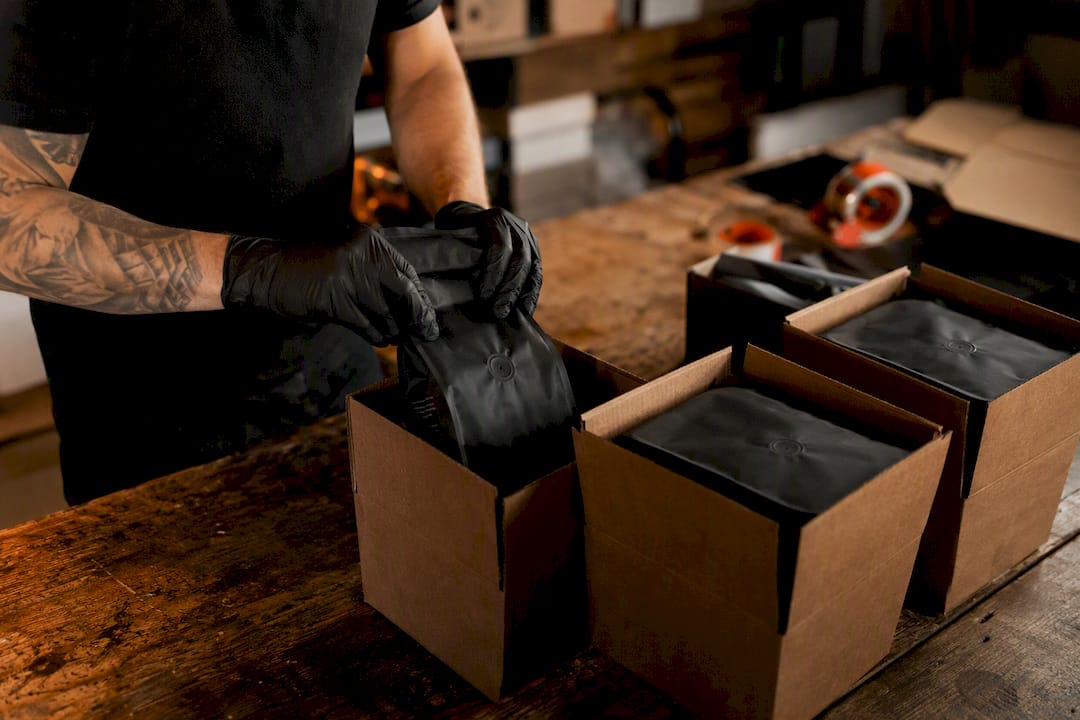
Once a bag is sealed, it moves through a pick-pack-check sequence: pulled from the queue, matched against the order, verified a second time, then boxed with a tracking number attached before it ever reaches a carrier.
Carrier choice depends mostly on weight and speed needs. Subscription shipments under a pound commonly move on USPS Priority Mail or Priority Mail Cubic, a 2 to 3 day baseline. Smart roasters build in a two-day buffer on top of that transit estimate, since freshness math falls apart fast if a shipment sits an extra day at a sorting facility.
A few situations call for different handling:
- Launch or limited-edition releases sometimes get expedited shipping to manage demand spikes
- International orders can face customs delays that a domestic tracking number won’t reflect
- Premium shipping tiers are worth offering when a customer needs guaranteed delivery by a date
The takeaway for any buyer: track the shipment, but plan around the buffer, not just the advertised transit window.
What Software Keeps Coffee Fulfillment Accurate?
Behind the scenes, most of this runs on a stack of purpose-built tools rather than spreadsheets and guesswork. Subscription platforms handle billing and self-serve portals. Order management systems centralize wholesale requests instead of leaving them scattered across email threads. Production planning software ties order volume directly to roast scheduling.
Platforms like Abyssal’s operational counterpart, RoasterTools, connect wholesale ordering, forecasting, and roast scheduling into one dashboard, so an order placed today gets slotted into a real production run instead of waiting on a manual spreadsheet update.
The payoff is straightforward: a subscription order lands on the next scheduled roast batch, not on inventory that’s already been sitting for two weeks.
What Should Customers Expect From Their Orders?
You should be able to see your roast date, change your grind, pause or skip a shipment, swap blends, and update your address, all from a self-serve portal. Lead times vary by order type: subscriptions ship 24 to 48 hours after roasting, retail one-offs often ship from stock, wholesale follows a weekly cadence, and private-label runs weeks to months out. For order edits, sample requests, or setting up a wholesale account, reach out to support directly rather than waiting on a renewal date to make changes.
Why The Flaming Bean Built Fulfillment This Way
We built our process around one idea: you shouldn’t have to guess how fresh your coffee is. Subscription orders ship roast-to-order, every bag carries a roast-date stamp, and our portal gives you real control over grind, pauses, and swaps.
A bag of Abyssal bought retail ships from ready stock. The same blend on subscription gets roasted to your billing cycle. Ordered wholesale, it follows a documented production run with batch codes and cupping records behind it. Every one of those paths runs on the same SOPs, and any wholesale or private-label partner can request the spec sheets and cupping data behind their batch.
Ready For Coffee That Ships The Way It Should?
Most roasters ask you to choose between fast shipping and real freshness. The Flaming Bean’s fulfillment process is built so you don’t have to pick one: subscriptions roast-to-ship inside a 48-hour window, every bag carries a roast date you can actually check, and your subscription portal lets you pause, skip, or swap without contacting support.
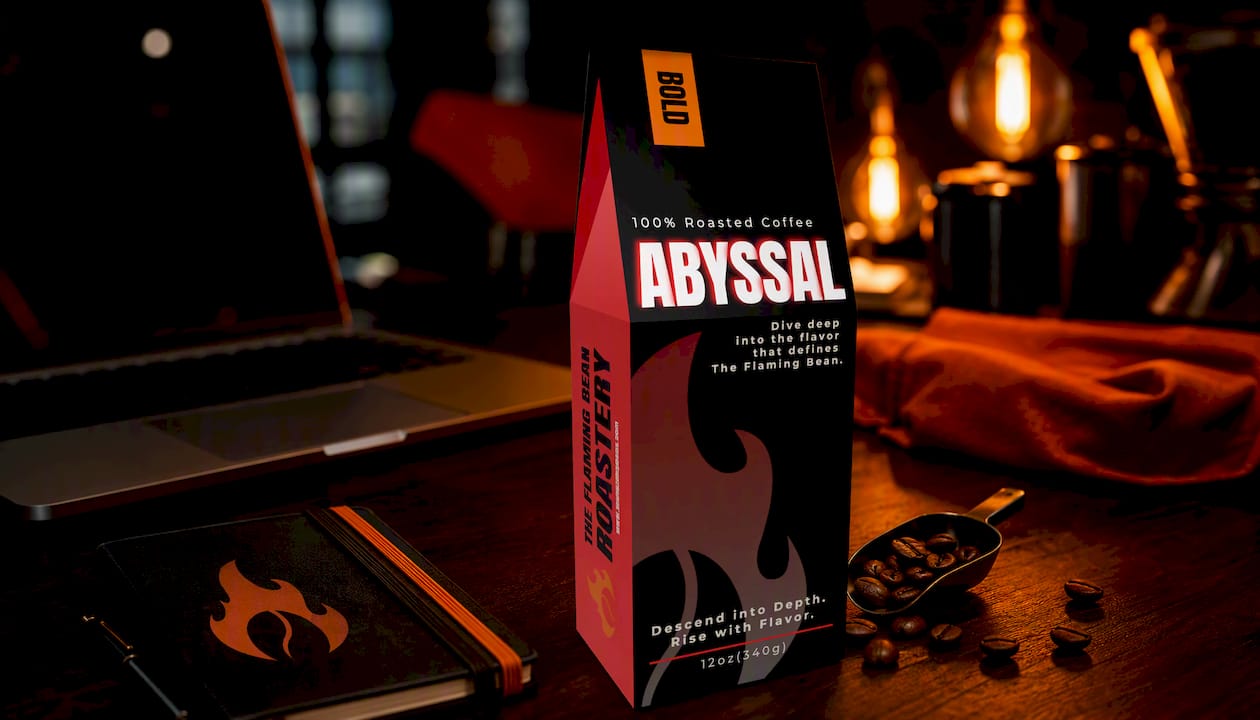
If you’re curious what that looks like in practice, start with a bag of Abyssal and watch the roast date on your own shipment. Running a business or nonprofit that needs volume? Wholesale and private-label inquiries typically get a response with spec sheets and sample options within a few business days. Shop retail, start a subscription, or send a wholesale request today, and see the roast date on your own bag before you even brew it.
Frequently Asked Questions
How long does coffee fulfillment usually take? Subscription and retail orders typically ship within 24 to 48 hours of roasting. Wholesale runs weekly, and private-label orders can take weeks to months depending on sample approval and spec sign-off.
What is coffee fulfillment, exactly? It’s the full process a roastery uses to turn a placed order into a shipped package: capturing the order, scheduling a roast batch, running quality control, packaging, and shipping with tracking.
Can I change my grind or pause a subscription? Yes. A self-serve subscription portal should let you set your grind preference, pause or skip a shipment, swap blends, and update your shipping address without contacting support.
Why does my bag have a batch code? The batch code ties your bag back to its exact roast date, green-coffee lot, and cupping record, which is how a roaster proves consistency between one bag and the next.
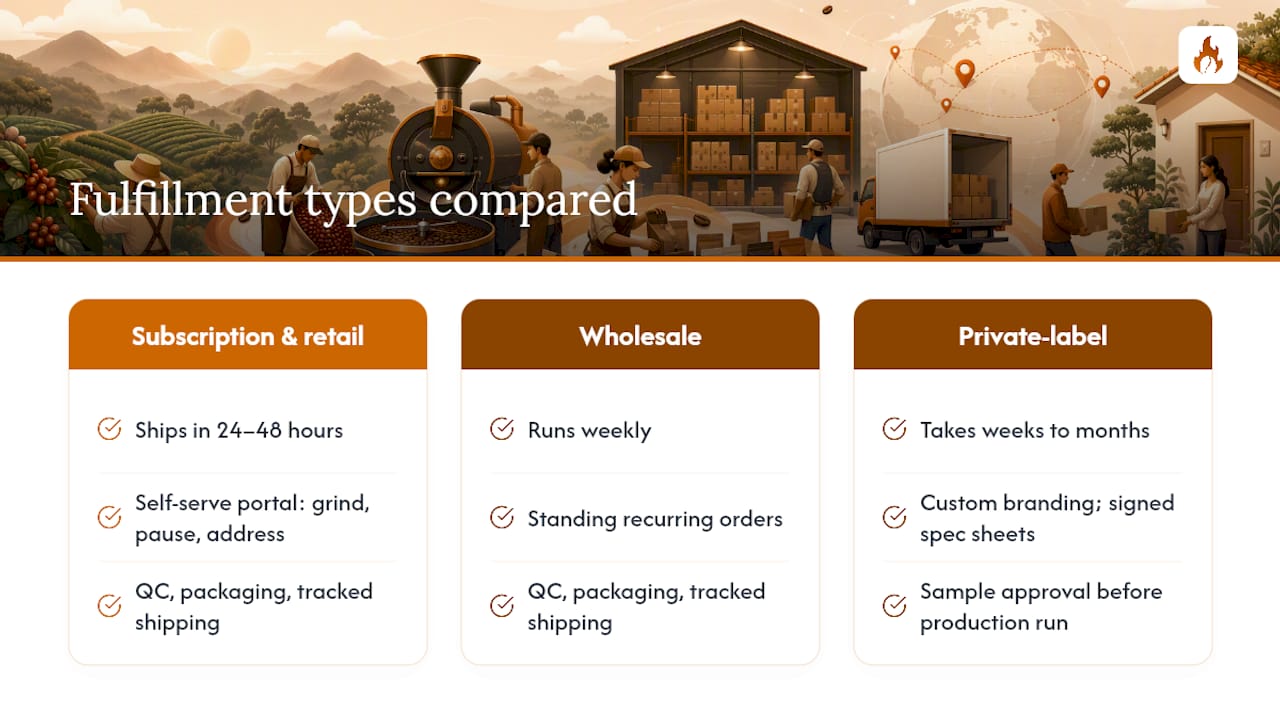
How is private-label coffee different from wholesale? Wholesale typically involves standing orders of existing blends on a recurring schedule. Private-label involves custom branding, signed spec sheets, and sample approval before a dedicated production run begins.
Comments