
Ethiopian Coffee: 6 Regional Flavors Home Tasters Should Brew

Ethiopian coffee flavor is defined by two forces: origin and processing. Washed lots deliver floral, tea-like clarity with citrus and jasmine; natural lots turn intensely fruity, wine-like, and heavy-bodied. Region shifts the specifics, from Yirgacheffe’s bergamot brightness to Guji’s jammy berry depth. The rest of this guide maps those differences region by region, so you know what to buy and how to brew it.
TL;DR:
- Region and processing method both heavily influence Ethiopian coffee flavor, with washed Yirgacheffe highlighting floral notes and naturals emphasizing fruitiness.
- Elevation, soil, and shade-grown cultivation at high altitudes between 1,500 and 2,300 meters boost brightness and complex aromatic profiles across the country’s microregions.
- Processing choices like washed, natural, or honey significantly alter flavor, with washed delivering clarity and naturals offering intense fruit and wine-like sweetness.
- Brew method and roast level shape flavor expression, with pour-over for washed coffees and French press or AeroPress best suited for naturals; light roasts preserve delicate floral and fruity notes.
- Comparing the same region processed differently reveals how fermentation and drying impact flavor more than region alone, aiding better understanding of Ethiopia’s flavor diversity.
Table of Contents
- What makes Ethiopian coffee flavor so distinctive
- Regional flavor profiles: Yirgacheffe, Sidamo, Guji, Harrar, Limu, and Kaffa
- How processing changes the flavor: washed, natural, and honey
- Terroir, altitude, and varietals behind Ethiopian coffee flavor
- How to brew and taste Ethiopian coffee for maximum flavor
- How roast level changes what you taste in Ethiopian coffee
- The Flaming Bean’s take on sourcing Ethiopian flavor
- Try Evening Roast to taste these flavors at home
- Why region-first thinking beats brand-first thinking
- Sources
What makes Ethiopian coffee flavor so distinctive
Ethiopian coffee tastes different from almost anywhere else on earth, and that starts with genetics. Ethiopia is the birthplace of Arabica, home to thousands of wild and semi-wild varieties that never went through the narrow breeding bottleneck most commercial coffee did. That genetic sprawl shows up as flavor complexity you don’t get from a single, standardized cultivar.
The most common tasting notes you’ll encounter include:
- Jasmine and orange blossom — floral, perfumed aromatics typical of washed high-altitude lots
- Bergamot and lemon — sharp citrus acidity, especially in Yirgacheffe and Sidamo
- Blueberry and stone fruit — jammy, syrupy sweetness common in natural-processed coffees
- Wine-like sweetness — a fermented, grape-like depth that shows up as lots age off the tree
- Black tea body — a light, brothy texture that lets aromatics dominate rather than heaviness
These notes aren’t marketing flourish. They trace back to altitude, soil, and processing choices made at the farm level, which is why two lots from neighboring hillsides can taste noticeably different. Ethiopia’s scale makes this variety possible in the first place.
Ethiopia is projected to produce 11.6 million 60-kg bags in marketing year 2025/26, according to USDA Foreign Agricultural Service data. That volume, spread across dozens of microregions and both major processing methods, is exactly why “Ethiopian coffee” isn’t one flavor. It’s a family of flavors, and learning to tell them apart is the whole point of this guide.
Regional flavor profiles: Yirgacheffe, Sidamo, Guji, Harrar, Limu, and Kaffa
Region is the first filter for predicting what’s in your cup, though processing (covered next) can override it. Here’s what to expect from each major growing area, plus how to brew for it.
Yirgacheffe is the benchmark for floral clarity. Washed Yirgacheffe lots typically show jasmine, bergamot, and a tea-like body so light it almost disappears on the tongue, letting the aromatics carry the cup. Natural-processed Yirgacheffe flips that script entirely: retail lots often list dark berry, chocolate, pomegranate, and floral balance as cupping notes, a much heavier, fruit-driven profile than the washed version. Brew washed Yirgacheffe on a V60 or Chemex with a light roast, and you’ll taste why it’s the region every specialty roaster points to first.
Sidamo covers more ground and more variation than any other Ethiopian region, which makes it harder to pin down but rewarding to explore. Washed Sidama lots commonly present jasmine, peach, lime, black tea, and blueberry, with careful drying producing a perfumed, delicate cup. Natural Sidamo swings toward brighter, more fruited profiles. Pour-over extraction and a light roast bring out the perfume; anything darker buries it.
Guji has become the region serious tasters chase for natural processing. Specialty roasters and press coverage highlight Guji naturals for dense fruit-forward profiles built around blueberry, plum, lemongrass, and rose, often with a wine-like complexity that borders on fermented. Guji’s Lalesa area in particular gets singled out for this berry-forward intensity. French press or AeroPress preserves the heavier body naturals carry.
Harrar is Ethiopia’s oldest commercially exported coffee and tastes like it comes from a different tradition entirely. Grown dry in the eastern highlands with no water source nearby, Harrar coffee is almost always natural processed, producing heavy body, mocha and dark chocolate notes, and a wine-like fruitiness closer to dried fruit than fresh berry. It’s the region to reach for if you want something that reads more like a dessert wine than a floral tea.
Limu, grown in southwestern Ethiopia, sits in between: a spiced, floral cup with sharper acidity than Yirgacheffe but less fruit intensity than Guji. It holds up well to slightly darker roasts, which round out the spice notes without erasing them the way a dark roast would flatten a delicate Yirgacheffe.
Kaffa is where coffee’s story arguably begins, the forest region many historians point to as Arabica’s original home. The cup reflects that wild heritage: balanced acidity and body with earthy, forest-floor undertones rather than the cleaner citrus or berry notes of more cultivated regions.
Pro Tip: Don’t assume region alone tells you what’s in the cup. Cupping notes from the same growing area can shift dramatically depending on how the lot was processed and handled after picking, so always check whether a bag says washed, natural, or honey before you brew.
How processing changes the flavor: washed, natural, and honey
Processing method often matters more than region for predicting flavor, and it works through simple mechanics.
- Washed process removes the cherry’s fruit and mucilage before drying the bean. That strips away fruity sugars during fermentation, leaving the clean, tea-like clarity and floral-citrus lift that define classic Yirgacheffe and Sidamo profiles.
- Natural process dries the whole cherry with the fruit still attached. The bean absorbs sugars and fermentation compounds from the drying fruit for days or weeks, producing the intense fruit, syrupy body, and wine-like sweetness associated with Guji and Harrar naturals.
- Honey or pulped-natural process splits the difference, removing the skin but leaving some mucilage on during drying.
Roasters choose honey processing for lots where they want:
- Some of the body and sweetness of natural processing
- Without the full fermentation intensity that can push a cup toward funky or overripe
A guide to honey-processed coffee covers exactly how that hybrid method changes what you taste, if you want to dig further into the mechanics.
Terroir, altitude, and varietals behind Ethiopian coffee flavor
Elevation is the single biggest terroir factor in Ethiopian coffee. Prized lots typically grow between roughly 1,500 and 2,300 meters above sea level, and higher elevation slows cherry maturation. That slower ripening concentrates sugars and aromatic compounds, which is a major reason high-grown Ethiopian lots taste brighter and more complex than lower-altitude coffee from other origins.
Beyond elevation, a few other factors shape the cup:
- Volcanic soil across Ethiopia’s highlands provides mineral density that supports acidity and sweetness
- Shade-grown cultivation in forest regions like Kaffa slows ripening further and adds earthy complexity
- Rainfall patterns tied to the country’s two growing seasons affect harvest timing and cherry development
Layer on Ethiopia’s wild Arabica genetic diversity, and you get a country where neighboring farms can produce genuinely different-tasting coffee from the same rainfall and similar soil. If you want a broader sense of how origin shapes flavor beyond Ethiopia specifically, a guide to coffee origins breaks down how terroir plays out across other growing regions too.
How to brew and taste Ethiopian coffee for maximum flavor
Method matters as much as bean here. Match your brewer to the processing style, and you’ll taste the difference immediately.
- For washed coffees (Yirgacheffe, most Sidamo): use a pour-over like a V60 or Chemex, a 1:16 ratio, water at 200 to 205°F, and a medium grind. Pour-over lets floral aromatics rise without extracting excess body.
- For natural coffees (Guji, Harrar): use a French press or AeroPress at a 1:15 ratio to capture more oils and body, which carries the fruit and wine-like sweetness these lots are known for.
- Taste in three stages. Sip hot first for aromatics, then again as it cools to catch fruit and sweetness that emerge at lower temperatures, then once more near room temperature. Ethiopian naturals in particular turn more fruit-forward and winey as they cool, so don’t judge a cup only on the first hot sip.
Pro Tip: Keep a simple notebook. Write down aroma, first sip, cooled sip, and aftertaste separately. Comparing notes across three or four cups is how your palate actually learns to spot jasmine versus bergamot versus blueberry. A coffee flavor wheel gives you the vocabulary to describe what you’re tasting more precisely.
How roast level changes what you taste in Ethiopian coffee
Roast level can preserve or erase everything discussed above, so it deserves its own decision separate from region and processing.
- Light roast preserves floral aromatics, bright acidity, and tea-like clarity, which is why nearly every washed Yirgacheffe and Sidamo you’ll find at a specialty roaster is roasted light.
- Medium roast balances fruit sweetness against early caramelization, a good middle ground for naturals where you still want berry notes but a bit more body and sweetness.
- Darker roast mutes delicate florals and fruit almost entirely, replacing them with chocolate and roast-driven flavors. It’s a legitimate choice for Limu or Harrar if you prefer body to brightness, but it erases most of what makes Yirgacheffe special.
For a deeper breakdown of how time and temperature during roasting reshape these notes, see this guide to roast levels and this explanation of how roasting shapes flavor development.
The Flaming Bean’s take on sourcing Ethiopian flavor
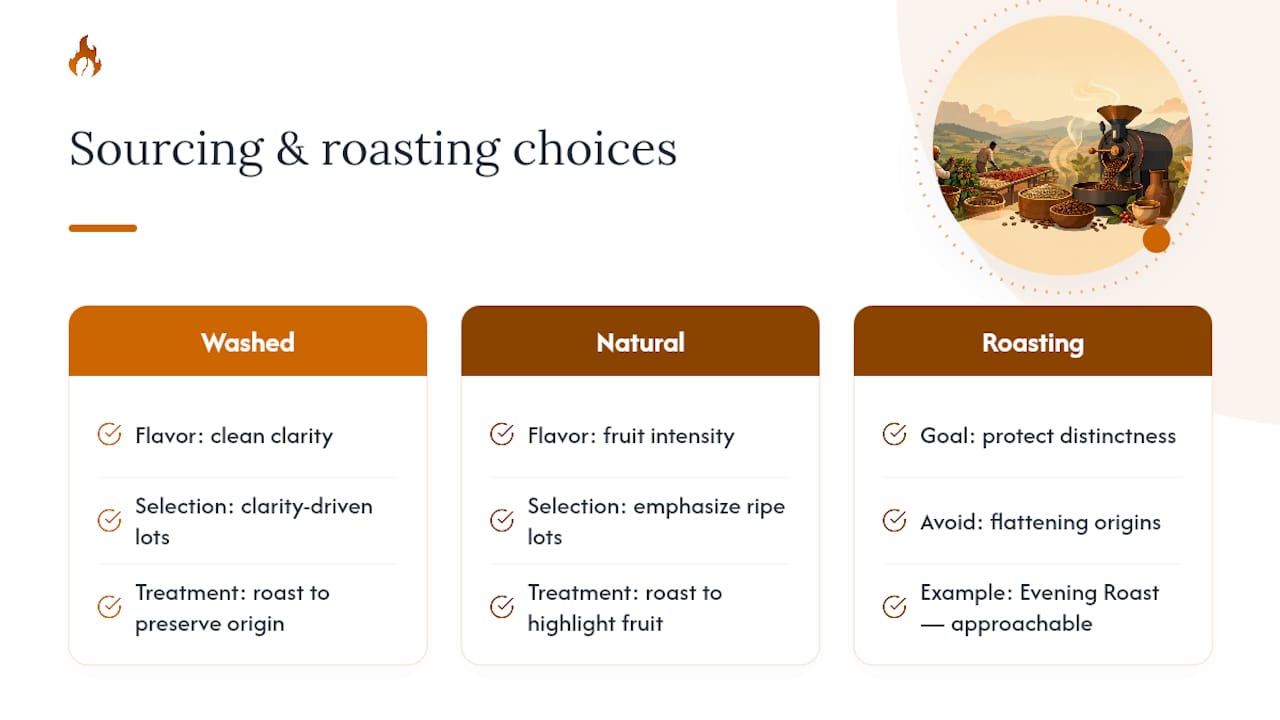
We look for lots where region and processing tell a clear story, not a muddled one. That means selecting washed lots for clarity and naturals for fruit intensity, then roasting each to protect what makes it distinct rather than flattening every origin into one house profile. [brand_signal]
Our Evening Roast draws on these same principles, built as an approachable entry point into the smoother, sweeter side of what Ethiopian and other origins can offer without demanding the same attention a delicate washed Yirgacheffe requires.
Try Evening Roast to taste these flavors at home
Evening Roast is designed for those seeking a smooth, comforting cup that offers rounded sweetness and body over sharp acidity, providing an approachable introduction to these flavor concepts.

Brew it the same way you’d brew a natural-processed lot: French press or AeroPress, a slightly coarser grind, and a 1:15 ratio to let its body come through fully. If tonight’s cup is meant to wind down the day rather than jolt you awake, Evening Roast is worth adding to your rotation. Order a bag and taste the difference a thoughtfully chosen roast makes.
Why region-first thinking beats brand-first thinking
Most coffee marketing sells you a name and a mood, not a flavor mechanism. That’s backwards for Ethiopian coffee specifically, because the country’s flavor range is wider than almost any other origin’s. Treating “Ethiopian coffee” as one flavor is like treating “French wine” as one flavor. It ignores the variable that actually predicts what’s in your cup.
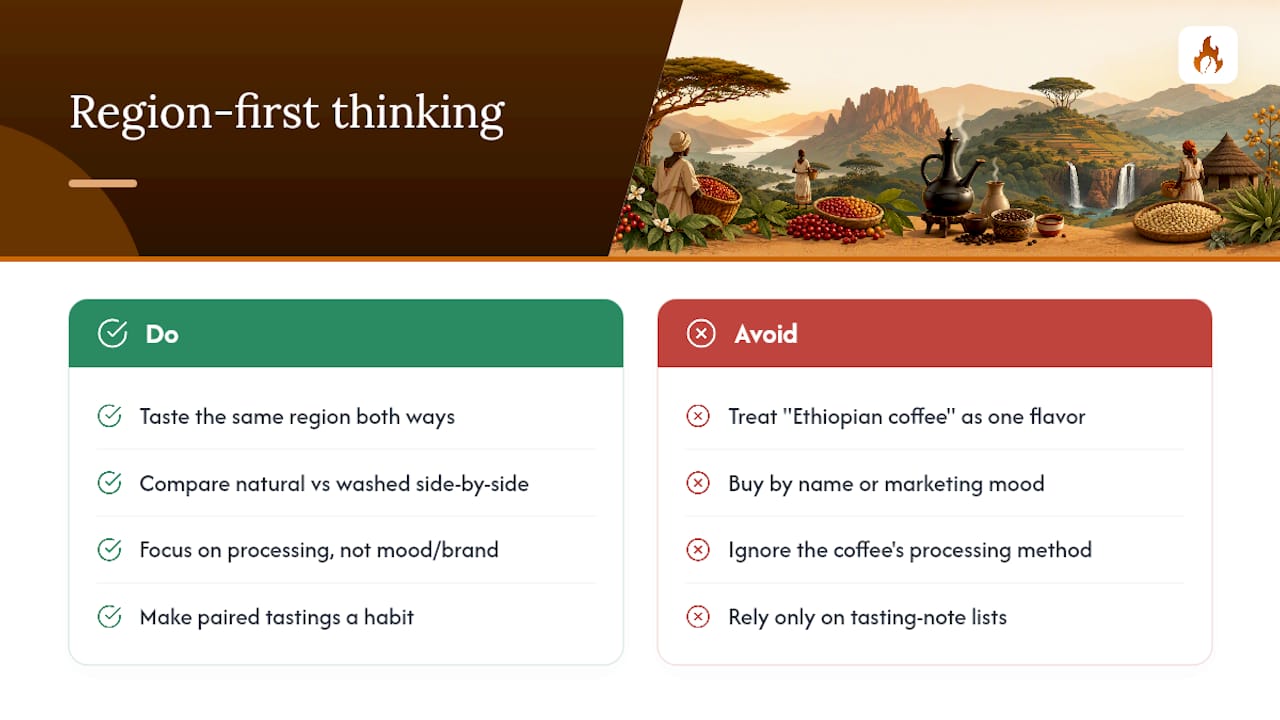
The processing method deserves more attention than it usually gets. Plenty of drinkers can tell you Yirgacheffe is floral, but far fewer know that a natural-processed Yirgacheffe tastes closer to a Guji natural than to a washed Yirgacheffe from the next valley over. Processing frequently overrides region, and most casual buying guides never say so.
If there’s one habit worth building, it’s tasting the same region across both processing methods side by side. That single comparison teaches your palate more about what altitude, soil, and genetics actually contribute versus what fermentation and drying contribute, than reading ten tasting-note lists ever will.
— Tony
Sources
- Coffee Annual_Addis Ababa_Ethiopia_ET2023-0014.pdf (USDA FAS)
- Ethiopian Coffee: Flavors and Varieties | JayArr Coffee
- Crown Jewel Ethiopia Sidama Daye Bensa Washed - Royal Coffee
- Perk & Recs: A Curated Selection Of Coffees From The Sprudge Roaster’s Village | Sprudge
Comments