
Dial In French Press Grind Size: 800–1,200 μm and Blends That Work

Use a coarse grind, about the texture of sea salt, sitting somewhere around 800 to 1,200 microns, and you’ve solved most French press problems before they start. Pair it with a 1:15 coffee to water ratio, water at 200°F, and a 4-minute steep. If your cup turns bitter, grind coarser. If it turns sour or thin, grind finer. Everything else in French press brewing is a variation on that one move.
TL;DR:
- Using a coarse grind between 800 and 1,200 microns prevents over-extraction and muddiness, ensuring a clean, full-bodied French press cup.
- Adjust grind size by about 100 microns to fine-tune extraction, with finer for sour cups and coarser for bitter or harsh results.
- Translate micron targets into specific grinder notches, starting points, and always adjust based on taste, roast level, and grinder wear.
- Treat grind size as a variable hypothesis, testing and refining with each new coffee bag rather than relying on a fixed setting.
- Choosing beans roasted specifically for immersion brewing, like Flaming Bean blends, complements grind size and simplifies dialing in a consistently good cup.
Table of Contents
- Why French Press Grind Size Matters More Than Any Other Variable
- How Grind Size Controls Extraction, Body, and Sediment
- Translating Microns Into Real Grinder Settings
- The Dial-In Order That Actually Fixes Bad Coffee
- A Repeatable Brew Checklist From Weigh-In to Decant
- The Flaming Bean’s Take on Brewing the Right Cup
- Reading Roast Level Into Your Grind Setting
- Our Take: Stop Treating Grind Size as a Fixed Number
- Blends Built to Perform in Your Press
- Sources
Why French Press Grind Size Matters More Than Any Other Variable
Coarse grind is the standard starting point for French press, and once you understand why, every other decision in this brewing method gets easier. The particles need to be big enough to survive four minutes submerged in hot water without dissolving too much of themselves into your cup.
Think in terms of texture you can picture. Coarse sea salt is the classic comparison, and it’s a good one because you probably have some in your kitchen right now. Rough breadcrumbs work too. What you’re avoiding is anything close to table salt or, worse, powdered sugar. That fine dust is built for drip machines and espresso, not for sitting in water with no paper filter to catch the debris.
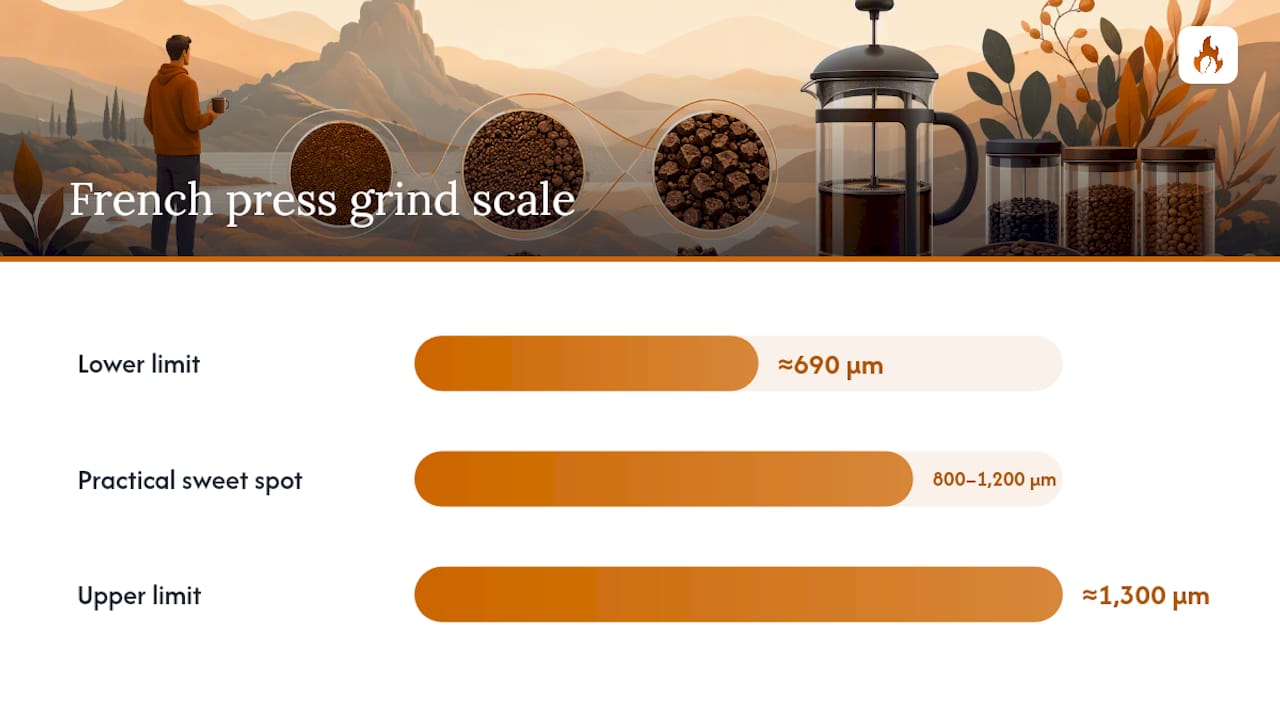
Measured in microns, the practical sweet spot lies between 800 and 1,200 μm, with the acceptable range stretching from roughly 690 to 1,300 μm depending on your grinder and taste preference. Here’s what those numbers translate to for the presses you actually own:
Water temperature should sit between 93 and 96°C (roughly 200 to 205°F), just off a full boil. And grind fresh, right before you brew. Pre-ground coffee starts losing its aromatic compounds within minutes of contact with air, so whatever grind size you dial in matters a lot less if the beans went stale a week ago.
How Grind Size Controls Extraction, Body, and Sediment
Extraction is a race against time and surface area. Smaller particles have more surface area exposed to water, so they release flavor compounds, oils, and caffeine faster than larger ones. A French press gives coffee four full minutes of contact time with no paper filter to stop the process early. That’s a long window, and it’s why grind size does more heavy lifting here than in almost any other brew method.
Grind too fine for that four-minute soak and you’ll pull far more dissolved solids than you want. The result is a cup that tastes bitter, harsh, and often chalky on the finish. Grind too coarse and you undershoot extraction entirely. You’ll get a thin, sour, underdeveloped cup that tastes like weak tea with coffee ambitions.
There’s a mechanical wrinkle unique to French press: the metal mesh filter. Unlike paper, mesh doesn’t trap the smallest particles, called fines. Those fines slip through into your cup, and that’s the source of the sediment sitting at the bottom of your mug.
- Fines increase body and mouthfeel, contributing to the fuller texture of French press coffee compared to pour over.
- Excessive fines create muddiness and an unpleasant gritty texture.
- A coarse grind helps produce fewer fines, balancing body with clarity.
A grind size shift of even 100 microns can noticeably change body and sediment in the finished cup. That’s a small adjustment on a grinder dial, but it’s often the difference between a cup you’re proud of and one you pour down the drain.
Translating Microns Into Real Grinder Settings
Micron numbers are useful for understanding the target, but no home grinder has a “900 μm” setting. You need to translate that target into clicks, notches, or dial numbers on the equipment you actually own.
A few real-world starting points, based on published grinder mappings:
- Baratza Encore: roughly 28 to 32 on the dial.
- Comandante hand grinder: roughly 28 to 30 clicks.
- Fellow Ode Gen 2: roughly 6 to 7 on the dial.
- 1Zpresso hand grinders: settings vary by model, but expect a range on the coarser third of the grinder’s total adjustment.
Treat these as starting points, not gospel. Every burr set wears differently, and roast level shifts things too, so the real method is this: pick a setting, brew, taste, then move a couple of clicks in whichever direction the cup tells you to go. Write the number down once you land on one you like. That’s your repeatable baseline.
| Grinder Type | Consistency | French Press Suitability |
|---|---|---|
| Blade grinder | Low, chops unevenly | Not recommended |
| Entry-level burr | Good, adjustable steps | Recommended |
| Precision hand grinder | Excellent, fine-tuned clicks | Highly recommended |
If your grinder maxes out too fine even on its coarsest setting, you have two options. Run the grounds through a coarse sieve, something around a 600-micron mesh, to knock out excess fines before brewing. Or accept that it’s time to upgrade to a grinder built for immersion brewing.
Blade grinders are the root cause of most muddy French press complaints, and they deserve to be named directly. A spinning blade chops beans into a chaotic mix of boulders and dust in the same batch, which means part of your grind over-extracts while another part under-extracts, simultaneously. You end up with a cup that’s bitter and sour at once, which is about the worst outcome French press can produce.
The Dial-In Order That Actually Fixes Bad Coffee
When a cup goes wrong, most people start randomly changing variables. That wastes coffee and time. The correct sequence is grind first, then time, then ratio, because grind size has the biggest single effect on extraction, and adjusting it in isolation tells you the most with the least guesswork.
- Cup tastes bitter or harsh: your grind is too fine, or you over-extracted. Move 2 to 3 notches coarser on your next brew and hold everything else steady.
- Cup tastes sour or thin: your grind is too coarse, or extraction fell short. Move a couple of clicks finer. If you go noticeably finer on purpose, shorten your steep to 2:30 to 3:00 instead of the full four minutes, since finer particles extract faster and will over-shoot at the standard time.
- Cup tastes weak but grind already looks right: add 30 to 60 seconds to your steep before touching the grinder again.
- Cup has excess sediment: this is often technique, not grind. Move to the plunge advice below before changing anything else.
Pro Tip: Press the plunger slowly and steadily, not in one hard shove. A gentle plunge acts like a second filter, pushing fewer fines through the mesh, while an aggressive press forces grit straight into your cup.
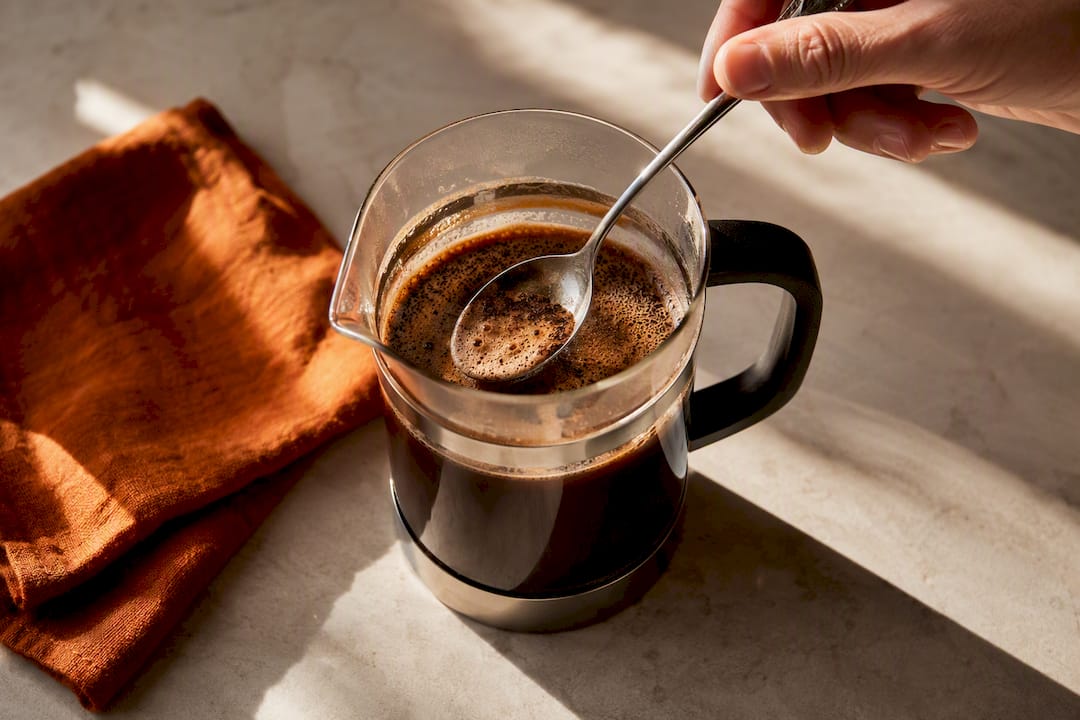
Once you’ve plunged, skim the top layer of foam and grounds with a spoon before pouring. It’s a small step that visibly reduces what ends up in your mug.
A Repeatable Brew Checklist From Weigh-In to Decant
Consistency comes from doing the same things in the same order every time, not from memory or guesswork. Here’s the sequence worth turning into habit:
- Weigh your coffee on a scale, using your press size’s ratio (1:15 is the reliable starting point).
- Grind fresh, right before brewing, at your dialed-in coarse setting.
- Preheat your press and your mug with hot water, then discard it.
- Add grounds, pour a small bloom pour to saturate them, and let it sit for 30 to 45 seconds.
- Pour the remaining water to your full target weight.
- Set a timer for 4 minutes and place the lid on with the plunger raised.
- At the 4-minute mark, skim any foam and floating grounds from the surface.
- Plunge slowly and steadily, using even downward pressure.
- Decant the entire brew into a separate carafe or mug immediately. Never leave coffee sitting on the grounds in the press.
- Rinse the press parts right away, and jot down your grind setting and any tweaks for next time.
That last step matters more than it sounds. A quick note on your phone turns each brew into data instead of a one-off guess.
The Flaming Bean’s Take on Brewing the Right Cup
The Flaming Bean sources beans from established growing regions and roasts them with French press drinkers specifically in mind, which shows up in how each blend behaves at that coarse, four-minute extraction.
- Evening Roast is built for balance. Its rounder, smoother profile holds up well against the fuller body a French press naturally produces, so you get richness without the roast fighting the brew method.
- Abyssal is the bolder pick, a deep, intense roast for drinkers who want their French press cup to hit hard. Its darker profile also extracts a touch faster, so starting slightly coarser than your usual setting keeps it from tipping bitter.
- Purpose-driven blends like Safe Ground pair a smooth, approachable flavor with proceeds that support meaningful causes, a fit for drinkers who want their morning cup to do more than taste good.
For deeper brewing fundamentals beyond grind size, The Flaming Bean’s guide to brewing better coffee at home covers the workflow this article builds on.
Reading Roast Level Into Your Grind Setting
Grind size doesn’t operate in a vacuum. Roast level changes how fast coffee extracts, and ignoring that is why the same setting can produce a great cup with one bag and a disappointing one with another.
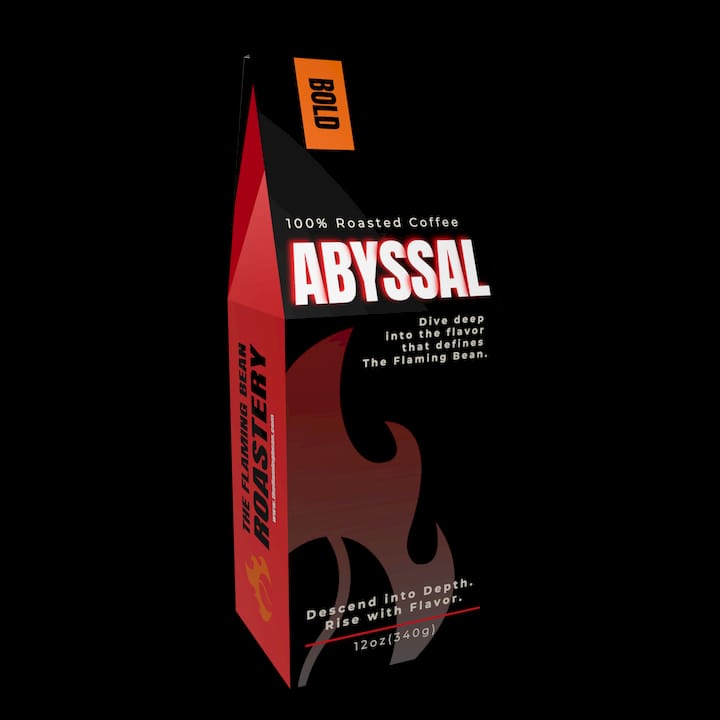
Dark roasts, like a bold blend such as Abyssal, have a more porous, brittle bean structure from longer time in the roaster. That structure extracts faster, so a dark roast ground at the same setting as a lighter one will often taste more bitter at the same brew time. The fix is small: start your grind about 2 clicks coarser than your normal baseline when brewing a dark roast, then taste and adjust from there.
Light roasts are denser and extract more slowly, so they typically need a setting a couple of notches finer to hit the same strength in the same four minutes. This is exactly why a single “correct” grind setting doesn’t exist across every bag of coffee you own.
Think of your dialed-in setting as a starting point per blend, not a universal number. Once you know how a specific roast behaves, adjusting by a couple of clicks becomes second nature instead of a guessing game. Log the setting for each blend you brew regularly, the same way you’d log a favorite recipe, and you’ll stop re-solving the same problem every time you open a new bag.
Our Take: Stop Treating Grind Size as a Fixed Number
The biggest mistake enthusiasts make with French press isn’t picking the wrong micron target. It’s treating grind size like a single number they set once and never touch again. Coffee is agricultural. Roast level shifts, bean density shifts, even humidity in your kitchen shifts how a grinder performs day to day. Conventional advice tends to hand you one setting and walk away, which sets people up to blame themselves when a cup goes sideways instead of blaming the variable that actually moved.
What the evidence in this guide supports is a mindset shift: treat your grind setting as a hypothesis you test every time you open a new bag, not a fact you memorize once. Grind first, taste, adjust by a couple of clicks, and only then touch time or ratio. That order works because grind size carries more weight than anything else you can change.
If you take one thing from this guide, make it this: buy a scale before you buy a fancier grinder. Precision in your ratio will fix more bad cups than a fancier burr set ever will.
— Tony
Blends Built to Perform in Your Press
Grind size gets you most of the way to a great cup, but the beans underneath that grind setting still do the real work. The Flaming Bean roasts specifically with immersion brewing in mind, which means less trial and error for you once you’ve dialed in your setting.
If you want a smooth, balanced cup that rewards a careful 1:15 ratio, Evening Roast is the one to start with. Its rounder profile plays well with the fuller body a French press naturally produces, so you taste the coffee, not the brew method fighting it. Want something bolder? Abyssal delivers a deep, intense cup built for drinkers who want their French press to hit like it’s supposed to. And if you’re brewing for someone whose blend preference you don’t know yet, a Flaming Bean Coffee Gift Card lets them pick their own starting point.
Every bag ships freshly roasted, which matters more than any grinder setting once your coffee is more than a couple of weeks old. Shop The Flaming Bean’s signature blends and get a bag on the way before your next brew.
Sources
- French Press Grind Size and Brew Time: The Complete Guide | BrewMark
- French Press Grind Guide: Eliminate Muddy Coffee | First French Press
- French Press Grind Size Explained (With Grinder Settings) | Coffee Craftery
- French Press Guide: Grind Size, Bloom & Avoiding Sediment | Flypresso
- Coffee extraction and how to taste it | Barista Hustle
Comments