
How Roasting Shapes Coffee Flavor Development

Roasting is defined as the heat-driven process that irreversibly transforms green coffee beans into the aromatic, flavorful product you brew every morning. The role of roasting in flavor development is the single most important variable separating a flat, grassy cup from one with bright acidity, rich sweetness, and complex aroma. Three chemical reactions drive this transformation: the Maillard reaction, caramelization, and Strecker degradation. Each one fires at a different temperature, produces different compounds, and contributes a distinct layer to the final flavor profile. Understanding how these reactions interact gives you real control over what ends up in your cup.
How do different roast levels affect coffee flavor and aroma?
Roast level dictates coffee flavor intensity and complexity. Light and medium roasts show higher flavor complexity than dark roasts. That finding is backed by physicochemical analysis showing measurable differences in density, caffeine, and phenolic content across roast stages.
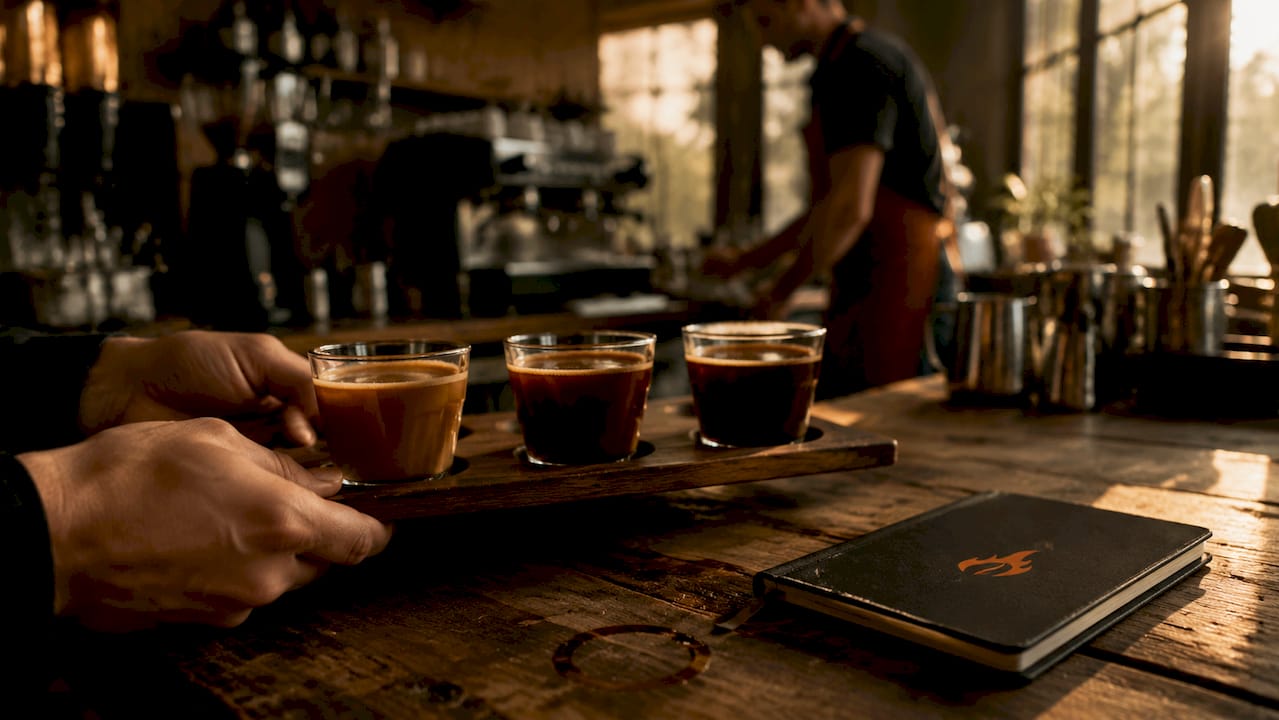
The table below shows how key attributes shift from light to dark:
| Attribute | Light roast | Medium roast | Dark roast |
|---|---|---|---|
| Density (g/ml) | 0.53 | 0.48 | 0.44 |
| Caffeine (%) | 1.40 | 1.25 | 1.11 |
| Phenolic content (mg EAG/g) | 36.54 | 31.00 | 26.32 |
| Flavor character | Bright, floral, acidic | Balanced, sweet, full body | Smoky, bitter, chocolate |
| Origin clarity | High | Moderate | Low |
Light roasts preserve the bean’s origin terroir. Ethiopian Yirgacheffe, for example, keeps its jasmine and citrus notes intact at a light roast because the volatile aromatic compounds have not yet been driven off by heat. The impact of roasting on flavor at this stage is mostly additive: you are building on what the bean already contains.
Medium roasts shift the balance. Citric acid decreases by 50–70% from light to medium roast. That acid reduction unmasks caramelization products, which is why medium roast coffee tastes sweeter even though all the original sucrose has been destroyed by this point.
Dark roasts push past sweetness into bitterness. Phenolic content drops to 26.32 mg EAG/g, and origin nuance disappears under smoky, carbon-forward notes. Body increases, but complexity falls. A dark roast from a single-origin Kenyan bean tastes nearly identical to a dark roast from a Brazilian blend because the heat has overwritten the bean’s individual character.
Pro Tip: If you want to taste what a specific growing region actually offers, brew it light. If you want a crowd-pleasing, forgiving cup, go medium. Save dark roasts for espresso blends where milk or pressure extraction benefits from the added body.
What are the key chemical reactions during roasting that develop flavor?
Roasting produces flavor through three distinct browning reactions, not one. Treating them as a single event is the most common mistake roasters make. Each reaction has its own temperature window, its own products, and its own contribution to the cup.
-
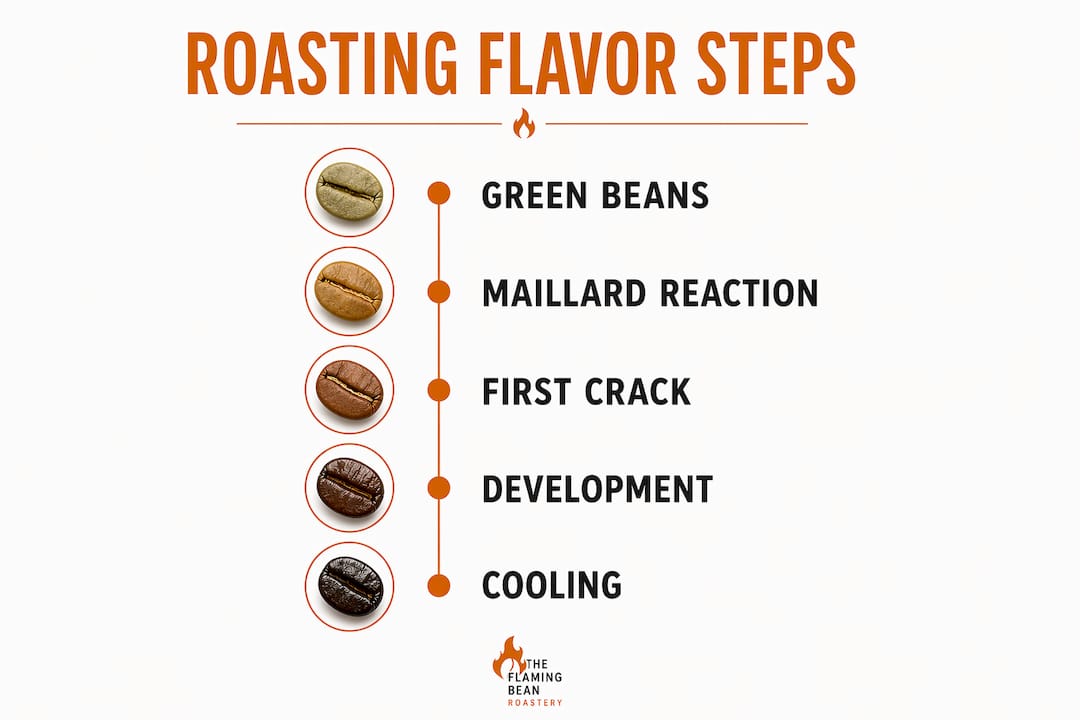
Maillard reaction (140–160°C): Amino acids and reducing sugars combine to form pyrazines, pyrroles, and melanoidins. Pyrazines deliver nutty and roasted notes. Melanoidins contribute body, color, and aroma binding. Maillard begins at 140–160°C and sets the foundation for everything that follows.
-
Caramelization (160–170°C): Thermal breakdown of sucrose and other sugars produces furanones and diacetyl. These compounds register as sweet, buttery, and caramel-like on the palate. Caramelization fires just after the Maillard reaction and builds on its foundation.
-
Strecker degradation (concurrent with Maillard): Amino acids react with carbonyl compounds to form aroma-active aldehydes and sulfur compounds. These include methanethiol and other volatile sulfur molecules that contribute to the characteristic “fresh roast” smell. Strecker degradation runs alongside the Maillard reaction and produces some of the most potent odorants in coffee.
“Roasting profiles are reaction engineering specifications, not merely temperature settings, critical for developing over 1,000 possible volatile compounds that define cup quality.” — JayArr Coffee Research
The sequence matters as much as the reactions themselves. Rushing through the early Maillard phase by applying too much heat too fast is called “crash roasting.” The result is a coffee that smells roasted on the surface but tastes hollow and underdeveloped underneath. “Baking” is the opposite problem: applying too little heat for too long stalls the reactions and produces a flat, papery cup. Both are avoidable with proper time-temperature control.
Pro Tip: Watch your Rate of Rise (RoR) during the Maillard phase. A steady, declining RoR from first crack onward signals that your reactions are progressing in sequence rather than stalling or spiking.
How do roasting techniques and profiles influence sensory experience?
The method you use to apply heat shapes the flavor profile as much as the temperature itself. Drum roasting and hot air roasting are the two dominant methods, and they produce noticeably different results.
| Method | Heat transfer | Body | Acidity | Best for |
|---|---|---|---|---|
| Drum roasting | Conduction + convection | Rich, full | Moderate | Complex blends, medium to dark |
| Hot air (fluid bed) | Convection only | Lighter | Bright, high | Light roasts, single origins |
Drum roasting provides even heat and develops rich body. Hot air roasting moves faster but can be less uniform, which affects volatile production and flavor consistency. The choice of method is not just about equipment preference. It is a decision about what flavor outcomes you are targeting.
Roast speed is the other major variable. Fast roasts preserve acidity and brightness but can leave the development phase short, resulting in thin body. Slow roasts build sweetness and body but risk baking if the temperature curve flattens too early. The goal is a profile where each phase, drying, Maillard, and development, receives the time it needs.
- Extending the drying phase removes moisture evenly and sets up uniform browning.
- Slowing the Maillard phase builds more pyrazine and melanoidin complexity.
- Shortening development time after first crack preserves acidity and origin character.
- Extending development time deepens sweetness and body at the cost of brightness.
Roasters who evaluate coffee roaster quality consistently look at these phase ratios as indicators of craft. A development time ratio of 20–25% of total roast time is a widely used benchmark for balanced medium roasts, though the ideal number shifts with bean density and moisture content.
What changes occur to coffee aroma compounds during and after roasting?
Coffee aroma is more fragile than most enthusiasts realize. Only around 30 volatile compounds have Odor Activity Values above 1 and actually contribute to what you smell in the cup. That is a surprisingly small number given that roasting can generate over 1,000 volatile compounds in total.
The most important of these is 2-furfurylthiol (2-FFT). It is the compound most responsible for the classic “fresh roasted coffee” smell. The problem is that it degrades fast. 84% of 2-FFT is lost within 60 minutes after brewing due to reaction with melanoidins. That is why coffee smells most intensely aromatic the moment it hits hot water, and why a cup left sitting for an hour smells noticeably flat.
The key aroma families and their behavior post-roast:
- Thiols (2-FFT, methanethiol): Deliver fresh roast and sulfurous notes. Degrade within hours of brewing and within days of roasting.
- Pyrazines: Nutty, roasted, earthy notes. More stable than thiols but still diminish with storage.
- Furanones: Sweet, caramel-like. Relatively stable and persist longer in stored coffee.
- Aldehydes (from Strecker degradation): Fruity and malty notes. Moderate stability.
Melanoidins bind aroma compounds during and after roasting, which influences how long flavor persists in the cup. This binding effect is a double-edged situation: melanoidins slow the release of some volatiles, which can extend perceived aroma in the cup, but they also permanently trap others, reducing the total aromatic intensity available to you.
Storage matters enormously. Whole beans stored in a sealed, valve-equipped bag at room temperature retain volatile compounds significantly longer than pre-ground coffee exposed to air. Grinding accelerates oxidation and aroma loss by increasing surface area. Brew within two weeks of roast for the best sensory experience.
Key takeaways
Roasting is a sequence of distinct chemical reactions that must be managed in order to produce a balanced, complex cup of coffee.
| Point | Details |
|---|---|
| Roast level changes chemistry | Density, caffeine, and phenolic content all shift measurably from light to dark roast. |
| Three reactions build flavor | Maillard, caramelization, and Strecker degradation each fire at different temperatures and produce different compounds. |
| Aroma fades fast | 84% of 2-FFT, the key fresh-roast odorant, is lost within 60 minutes of brewing. |
| Roasting method matters | Drum roasting builds body; hot air roasting preserves acidity and brightness. |
| Freshness is non-negotiable | Brew within two weeks of roast date to capture the full volatile aroma profile. |
Why most people misread what roasting actually does
Here is the thing I keep coming back to after years of tasting and talking about coffee: most enthusiasts think of roasting as a dial you turn from light to dark. It is not. It is closer to conducting three separate chemical processes simultaneously, each one sensitive to time and temperature in its own way.
The sweetness you taste in a well-pulled medium roast is not residual sugar. Sucrose is fully destroyed by the time you hit medium roast. What you are tasting is a sensory illusion created by acid degradation uncovering caramelization products underneath. Once I understood that, I stopped chasing “sweet beans” and started paying attention to roast curves instead.
The other thing I see aspiring baristas get wrong is treating dark roast as the safe default. It is actually the least forgiving option for showcasing a bean’s origin. If you are working with a high-quality single-origin from Colombia or Kenya, a dark roast erases the very qualities that make it worth buying. Match the roast level to the bean’s character, not to your personal comfort zone.
If you want to go deeper, spend time with a roaster who will walk you through their profile decisions. Ask why they extended the drying phase or why they dropped the bean at a specific temperature. That conversation will teach you more about flavor balance in coffee than any tasting note ever could. And if you are home roasting, start with a consistent green bean source and change one variable at a time. Science works best when you control your experiments.
— Tony
Roasting expertise in every bag from The Flaming Bean
The science of roasting only matters if someone applies it with care. At The Flaming Bean, every roast decision reflects exactly the kind of intentional profile engineering this article covers.
The Evening Roast is a great example. It is crafted as a smooth, approachable medium roast that lets caramelization products shine without pushing into bitter territory. The flavor balance you read about above is built right into that bag. If you want to put your brewing setup to work, pairing a quality roast with the right grind makes a real difference. The Flaming Bean’s coffee grinders are selected to help you extract the volatile compounds your roaster worked hard to preserve. Great roasting and great grinding go together.
FAQ
What is the role of roasting in flavor development?
Roasting triggers the Maillard reaction, caramelization, and Strecker degradation, which collectively transform green beans into coffee with complex aroma, acidity, sweetness, body, and bitterness. Without roasting, green coffee has no meaningful flavor.
Why does medium roast taste sweeter than light roast?
The sweetness in medium roast is not from sugar. Citric acid decreases by 50–70% from light to medium roast, and that acid reduction uncovers caramelization products that register as sweet on the palate.
How quickly does coffee aroma fade after roasting?
Key volatile compounds like 2-furfurylthiol degrade rapidly. 84% of 2-FFT is lost within 60 minutes of brewing, and the broader aroma profile fades noticeably within days of roasting if beans are stored improperly.
What is crash roasting and why does it hurt flavor?
Crash roasting applies too much heat too fast, rushing through the Maillard phase before complex volatiles can fully develop. The result is coffee that smells roasted but tastes hollow and underdeveloped in the cup.
Does the roasting method affect flavor?
Yes. Drum roasting uses conduction and convection to build rich body and even browning. Hot air roasting relies on convection alone, which is faster but can produce less uniform results and a lighter body with brighter acidity.
Comments