
How Origin Claims Build Real Coffee Brand Credibility

Yes, origin claims genuinely affect whether buyers trust your coffee and what they’ll pay for it. The role of origin claims in brand credibility is well-documented across peer-reviewed research, industry analysis, and real purchasing behavior. Here’s the short version:
- Origin signals quality. Buyers can’t taste before they buy, so a named farm, region, or lot acts as a proxy for what’s in the bag.
- Traceability cuts search costs. Wholesale buyers and retailers spend less time vetting suppliers when provenance is documented and verifiable.
- Stories create loyalty. Narrative branding tied to a specific origin increases buyer engagement and perceived product distinctiveness.
A Queen’s University study found that traceable Ethiopian coffees commanded a $0.66 USD/kg premium over non-traceable lots in the examined export period. That’s not a rounding error. It’s the market pricing in trust.
Key Takeaways
Origin claims and traceability are the most direct levers a roaster has for building buyer trust, justifying specialty pricing, and winning repeat wholesale business.
| Point | Details |
|---|---|
| Traceability commands premiums | Traceable Ethiopian coffees averaged a $0.66 USD/kg higher export price than non-traceable lots. |
| Origin shapes expectations | Origin acts as an extrinsic cue that sets taste and quality expectations before the first sip. |
| On-pack hierarchy matters | Sensory claims and SCA scores attract the most visual attention; place them front and center. |
| Vague claims backfire | Missing lot info or unsupported direct-trade language erodes buyer trust faster than no claim. |
| The Flaming Bean | Evening Roast and Safe Ground both carry origin storytelling and documentation for wholesale buyers. |
Table of Contents
- Why origin transparency influences buyers and consumers
- How origin claims build credibility: the mechanisms behind it
- What makes an origin claim actually believable
- What to put on the bag so origin claims drive purchase intent
- Common pitfalls that damage credibility
- What wholesale buyers and retailers should request before committing
- How The Flaming Bean applies origin claims and transparency in practice
- Why provenance is the one thing you can’t fake long-term
- The Flaming Bean’s wholesale and private-label programs
- Sources
Why origin transparency influences buyers and consumers
Single-origin coffees in the U.S. consistently command higher retail prices than commodity blends because origin functions as a quality proxy, reducing the information gap between roaster and buyer. When a bag says “Yirgacheffe, washed process, 87 SCA,” the buyer doesn’t need to guess. The claim does the work.
For wholesale buyers and retailers, that reduction in uncertainty is commercially meaningful. Fewer returns, fewer quality disputes, and faster reorder decisions. Industry analysis from Aalto University confirms that roasters implementing deep transparency practices gain measurable competitive advantages through stronger consumer trust and repeat purchase behavior.
The emotional side matters too. Buyers want to feel good about what they’re selling. A coffee tied to a named cooperative in Guatemala or a family farm in Colombia gives a retailer something to talk about. That story becomes part of their own brand.
How origin claims build credibility: the mechanisms behind it
Origin claims work through three overlapping mechanisms: signaling, narrative identity, and institutional verification.
Signaling is the most direct. Research confirms that origin information acts as an extrinsic cue that shapes taste and quality expectations before the first sip. A buyer who sees “single-origin Ethiopia” expects brightness and florals. That expectation, when met, reinforces trust.
Narrative identity is what keeps buyers coming back. When a roaster publishes a producer’s name, a harvest date, and a processing story, the coffee becomes a character rather than a commodity. That specificity is hard to fake and easy to verify.
Institutional verification closes the loop. Eye-tracking research with specialty coffee consumers shows that sensory claims, SCA scores, origin, and traceability attract central visual attention and correlate positively with purchase intention. Buyers look for these cues first. When they find them, they buy.
- Origin reduces information asymmetry between roaster and buyer.
- Traceability documentation supports price negotiations in wholesale settings.
- SCA scores and cupping notes give buyers an objective anchor for quality claims.
- Forensic origin testing (isotopic fingerprinting) can independently verify high-value single-farm lots.
What makes an origin claim actually believable
Credible claims combine specific provenance, third-party or forensic verification, and accessible traceability data. Vague language like “sourced from Africa” doesn’t cut it with informed buyers.
Here’s what buyers expect to see:
- Farm or cooperative name (not just a country or region)
- Lot number and harvest date
- Processing method (washed, natural, honey)
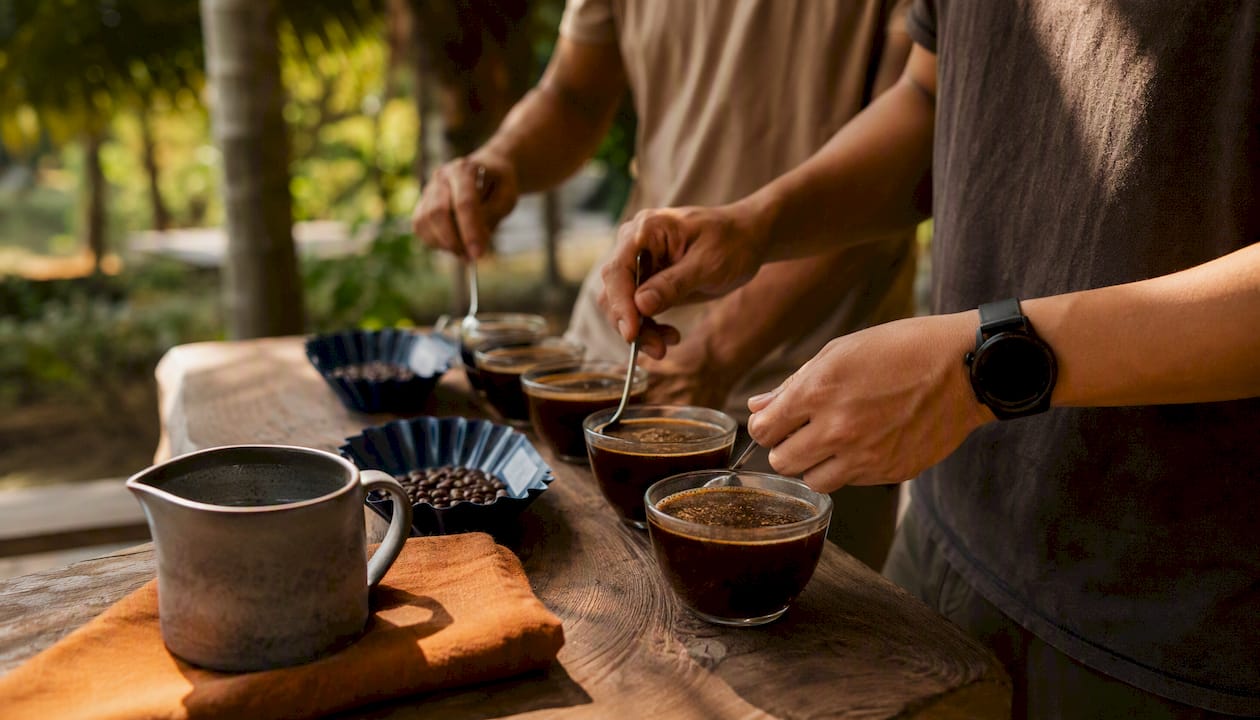
- Cupping score (SCA-graded, ideally from an independent cupper)
- Export and trade documents available on request
- Traceability platform link or QR code pointing to producer-level data
Traceability platforms and forensic origin testing let consumers access granular origin data quickly and increase brand loyalty when made accessible at the point of purchase. Roasters who publish this level of detail see less price resistance and higher customer retention.
Direct trade, when executed as a genuine commercial practice, also enables better supply-chain control, improved quality consistency, and collaborative pricing with producers. Treat it as a risk-management tool, not just a marketing phrase. Forward purchasing, contract terms, and collaborative cupping protocols protect both sides.
Pro Tip: Present provenance in tiers: region first, then farm, then lot. Consumers absorb the region-level claim quickly; the farm and lot details satisfy buyers who need documentation. You don’t have to lead with the lot number on the front of the bag.
What to put on the bag so origin claims drive purchase intent
Place sensory and origin cues in the central visual zone of your packaging. Peripheral space is for mandatory regulatory info. That’s the finding from eye-tracking studies on specialty coffee labels, and it’s a simple principle to apply.
The recommended on-pack hierarchy:
- Sensory claim or SCA score (front and center)
- Origin and traceability cue (farm name, region, or “traceable lot”)
- Roast level and variety
- Two-sentence origin story, followed by a QR code for deeper documentation
Keep the origin narrative to two sentences on the bag. Eye-tracking data shows consumers mostly read the first two sentences of longer origin copy. Put the full producer profile, lot photos, and export documents behind a QR code that loads fast. A landing page that takes more than 30 seconds to load loses the buyer before they’ve read anything.
For practical guidance on coffee brand packaging design, the layout decisions you make directly affect how much attention your origin claims receive. Typography contrast and visual hierarchy aren’t aesthetic choices. They’re conversion decisions.
Common pitfalls that damage credibility
Vague or unverifiable claims hurt a brand more than having no claim at all. A buyer who catches an inconsistency in your origin story doesn’t just walk away. They tell other buyers.
Red flags that erode trust:
- Missing lot numbers or harvest dates
- “Direct trade” language with no supporting documents
- Cupping scores that vary between the bag and the product page
- Sustainability imagery (green leaves, farmer photos) with no third-party certification
- Country-only origin claims on specialty-priced SKUs
Mitigation is straightforward. Audit your supply chain annually. Publish trade documents on request. Use independent verification partners for high-value lots. If a label claim changes because a supplier changes, update the packaging promptly. Buyers notice when the story on the bag doesn’t match the invoice.
The commercial consequences of getting this wrong include higher return rates, lost wholesale contracts, and social-media scrutiny that’s hard to walk back.
What wholesale buyers and retailers should request before committing
Buyers should validate provenance, traceability, quality metrics, and commercial terms before signing with any supplier. Here’s a practical checklist:
- Lot certificate from the exporter or cooperative
- Cupping notes and SCA score from an independent or third-party cupper
- Producer contact information (name, farm, or cooperative address)
- Traceability platform link or digital documentation package
- Recent export invoices showing origin and volume
- Processing and harvest date documentation
Negotiation points worth pressing:
- Commitment to repeat volumes at consistent quality
- Price-protection language tied to harvest variability
- Quality remediation clauses if cup scores fall below agreed thresholds
Quick red-flag screening: mismatched paperwork (invoice says one country, bag says another), producer names that can’t be verified online, and certifications that don’t appear in the certifying body’s public database. Fair Trade USA, Rainforest Alliance, and USDA Organic all maintain searchable registries. Use them. For a deeper look at what coffee certifications actually cover, that’s a useful starting point before your next supplier conversation.
How The Flaming Bean applies origin claims and transparency in practice
The Flaming Bean combines clear on-pack origin cues, accessible traceability content, and wholesale documentation to back every claim it makes. That approach maps directly to what buyers and retailers expect.
Two products show this clearly:
- Evening Roast is built around approachability and sensory clarity. The product page communicates roast character and flavor expectations in plain language, giving retail buyers a straightforward story to carry to their customers.
- Safe Ground layers origin transparency with mission-driven storytelling. The blend supports organizations protecting vulnerable individuals, and that purpose is woven into the product’s identity. For wholesale buyers, that narrative reduces price resistance because the purchase carries meaning beyond the cup.
Both products reflect The Flaming Bean’s broader approach: brand differentiation through origin and storytelling rather than commodity positioning. Wholesale buyers who carry these SKUs get documentation support, cupping notes, and a sourcing story they can actually use in their own marketing.
Why provenance is the one thing you can’t fake long-term
Here’s what most roasters underestimate: buyers aren’t just buying coffee. They’re buying confidence. Confidence that the quality will be consistent, that the story is real, and that they won’t be embarrassed in front of their own customers.
Origin claims are the fastest way to build that confidence, and the fastest way to destroy it. A roaster who publishes lot-level traceability, shares cupping notes, and makes trade documents available on request is doing something most competitors won’t bother with. That gap is a real commercial advantage.
The mistake I see most often is treating origin storytelling as a marketing add-on rather than a sourcing discipline. The story has to be true before it goes on the bag. When it is, buyers feel it. When it isn’t, they find out.
If you’re thinking about wholesale or private-label sourcing and want to talk through what documentation and traceability look like in practice, that conversation is worth having.
The Flaming Bean’s wholesale and private-label programs
The Flaming Bean offers wholesale and private-label programs built around origin transparency and documentation from day one. You get repeat-volume contracts, cupping score sharing, and traceability data for every SKU, plus private-label packaging support that puts your brand on a product with a real sourcing story behind it.
Products like Evening Roast and Safe Ground are available through wholesale, and both come with the origin documentation and brand narrative that make them easy to sell. Explore the full signature blends collection to see what’s available, or reach out directly to start a wholesale conversation. The sourcing story is already built. You just bring it to your customers.
Sources
- Which on-pack information drives a marketable specialty coffee label? (MDPI Foods)
- Extrinsic cues and food choice: how origin shapes expectations (ScienceDirect)
- Aalto University industry analysis on traceability and roaster competitive advantage
- How to ensure direct trade in coffee makes commercial sense - Perfect Daily Grind
- Mercanta’s traceability platforms and customers’ engagement — Digital Coffee Future
Comments