
What Does Co-Roasting Mean for Coffee Brands?

Co-roasting is defined as renting time and capacity on an established roastery’s equipment so that a coffee brand can produce its own roast without owning a commercial roaster. The practice answers a real problem for emerging brands: professional roasting equipment costs tens of thousands of dollars, yet the market needs to be proven before that investment makes sense. Understanding what does co-roasting mean gives you a clear picture of how small and mid-size brands get quality coffee to market fast, without betting everything on a machine. The Flaming Bean sees this model play out constantly in the specialty coffee world, and it shapes how new brands think about sourcing, quality, and identity.
What does co-roasting mean as a business model?
Co-roasting is a shared-production arrangement where a coffee brand books time at a licensed roastery, uses the facility’s drum or air roaster, and labels the finished product under its own brand. The host roastery provides the equipment, the space, and often the technical oversight. The visiting brand brings its green coffee, its roast profile, and its packaging.
The model exists because brands moving under 110 lbs monthly rarely justify the capital cost of owning a commercial roaster. That 110 lb threshold is the industry’s informal line between “co-roast it” and “buy your own machine.” Staying below that volume while paying for equipment, maintenance, and a dedicated space eats margins fast.
Co-roasting spaces typically operate on membership or per-session pricing. A brand books a slot, arrives with green beans, roasts to its approved profile, and leaves with finished, packaged product. Some facilities offer additional services like green coffee storage, nitrogen flushing, and quality-control cupping. Sharing these resources lowers the financial barrier and creates a community of emerging roasters who often trade knowledge freely.
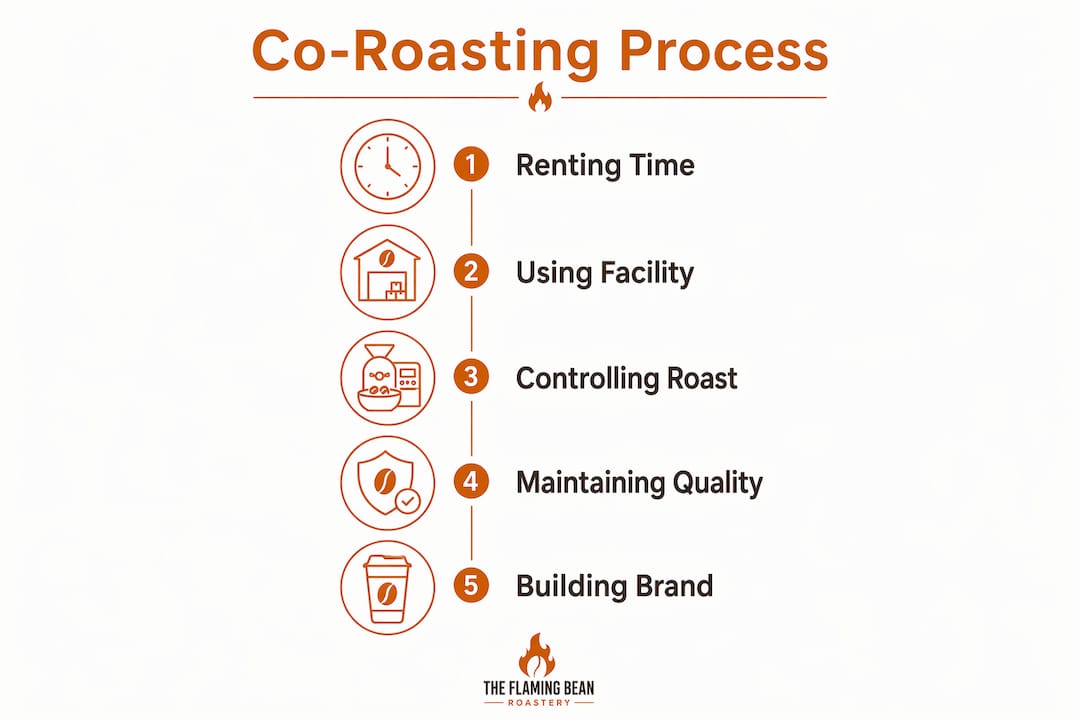
Here is how a typical co-roasting session runs from start to finish:
- Book a session. The brand reserves a time slot at the co-roasting facility, usually days or weeks in advance.
- Deliver green coffee. The brand brings its sourced, unroasted beans to the facility before the session.
- Set the roast profile. The brand works with the facility’s roastmaster to program the target time, temperature curve, and airflow settings.
- Roast and monitor. The session runs with the brand’s representative present to approve the roast and make real-time adjustments.
- Cup and approve. A quick cupping confirms the batch meets quality standards before packaging begins.
- Package and label. The finished coffee goes into the brand’s own bags with its own labels, ready for sale.
Pro Tip: Keep a written roast log for every session. Environmental variables like ambient temperature and humidity shift roast outcomes, and a log lets you replicate a great batch or diagnose a bad one.
How does co-roasting differ from co-fermentation?
Co-roasting and co-fermentation sound similar, but they describe completely different stages of coffee production. Mixing them up is one of the most common points of confusion in specialty coffee conversations.
Co-fermentation is a farm-level processing method where non-coffee ingredients are added during the fermentation stage to influence the bean’s flavor chemistry before it ever reaches a roaster. Common additives include fruits like melon and strawberry, as well as spices. These ingredients create flavor profiles that are integrated into the bean itself, not layered on after roasting.
Co-roasting, by contrast, happens entirely after the farm. It is a post-origin, operational business model. The bean’s chemistry is already set when it arrives at a co-roasting facility. The roasting process then develops that chemistry through the Maillard reaction and caramelization, which professional roasting profiles are designed to control with precision.
The key distinctions are:
- Stage: Co-fermentation happens at origin during processing. Co-roasting happens at a roastery after green coffee is sourced.
- Purpose: Co-fermentation shapes bean chemistry and flavor at a biological level. Co-roasting shapes flavor through heat and time.
- Who does it: Co-fermentation is managed by farmers and processors. Co-roasting is managed by coffee brands and roastmasters.
- Impact on the bean: Co-fermentation changes the bean’s physical and chemical composition. Co-roasting does not alter the bean’s origin character, it reveals and develops it.
Using these terms interchangeably frustrates both farmers and roasters. A producer who spent months perfecting a co-fermented lot deserves accurate language. A brand using co-roasting deserves the same clarity about what its model actually involves.
How does co-roasting affect quality, sourcing, and brand identity?
Co-roasting gives a brand real control over its roast profile while removing the burden of equipment ownership. That is a meaningful trade-off, and it cuts both ways.
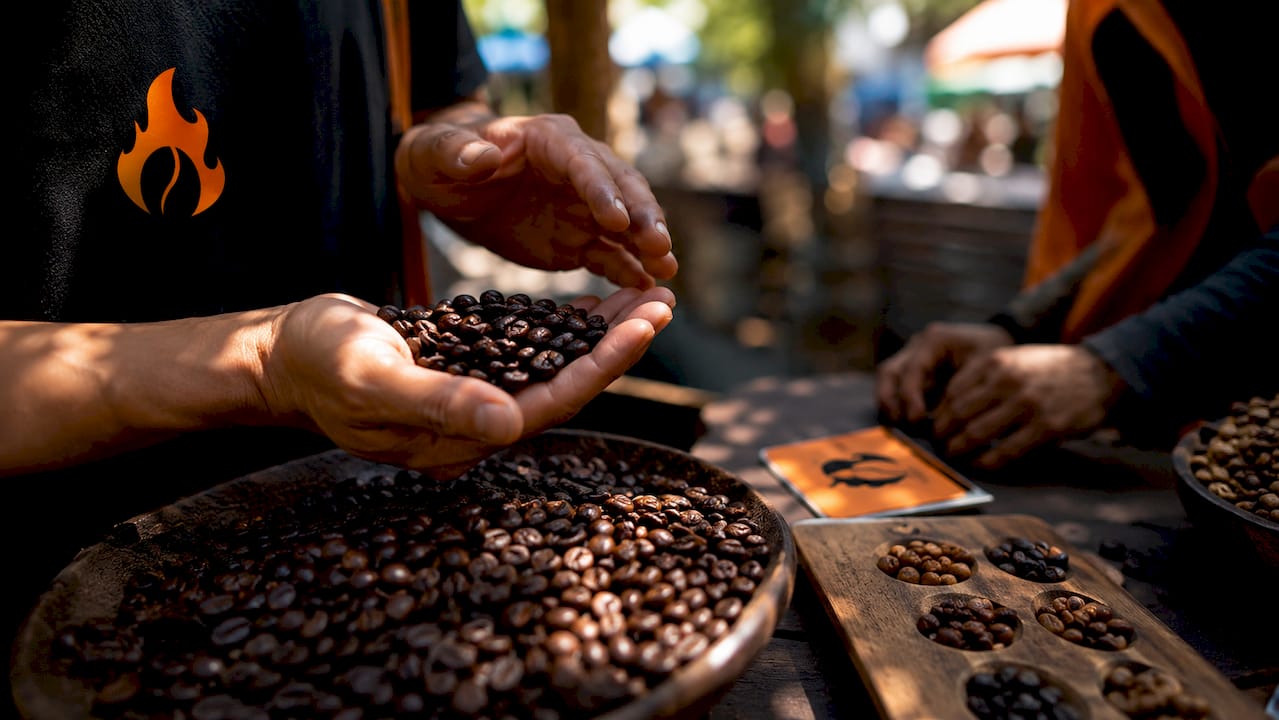
On the quality side, industrial roasting equipment at co-roasting facilities is often better than what an early-stage brand could afford to buy. Drum roasters and air roasters at established facilities are calibrated, maintained, and monitored. A brand roasting on well-maintained commercial equipment often produces a more consistent result than it would on a budget starter roaster purchased outright.
Environmental variables like ambient temperature and airflow affect every roast. Co-roasting facilities that track these variables give visiting brands data they can use to maintain batch-to-batch consistency. That is a quality advantage that many new brands underestimate.
Sourcing flexibility is another real benefit. Because the brand is not tied to a roaster’s house green coffee program, it can source beans from any origin, any importer, or any direct-trade relationship it builds. The brand controls the green coffee. The facility controls the equipment. That separation keeps sourcing decisions firmly in the brand’s hands.
Brand identity in a co-roasting model depends entirely on how the brand shows up beyond the roast. The coffee goes out in the brand’s packaging, under the brand’s name, with the brand’s story attached. Customers never see the shared facility. What they see is the label, the bag design, and the custom coffee branding the brand has built.
| Factor | Co-roasting advantage | Co-roasting limitation |
|---|---|---|
| Equipment quality | Access to professional, maintained roasters | No permanent control over scheduling |
| Sourcing | Full freedom to choose green coffee | Must transport green beans to facility |
| Consistency | Facility tracks environmental data | Shared space means variable conditions |
| Brand identity | Full label and packaging control | Production location is not your own |
| Cost | No capital equipment investment | Per-session fees add up at higher volumes |
Pro Tip: Use the co-roasting phase to build your roasting flavor knowledge before you own equipment. Every session is a free education in how heat, time, and airflow interact with your specific green coffees.
When should you move from co-roasting to owning your own roaster?
The right time to buy a roaster is when your sales volume makes co-roasting more expensive than ownership. That crossover point is real, and most industry professionals put it near or above the 110 lb per month mark. Below that threshold, co-roasting is more cost-effective than purchasing and running your own machine.
The financial case for ownership includes more than the roaster’s purchase price. Factor in installation, ventilation requirements, insurance, maintenance contracts, and the labor cost of someone who can operate the machine safely and consistently. These costs are real and recurring. Co-roasting fees, by comparison, scale directly with volume and stop when you stop roasting.
The strategic case for staying in co-roasting longer than you think you need to is strong. Industry experts advise treating co-roasting as a temporary but deliberate phase focused on proving the brand, not perfecting the production process. The brands that grow fastest during this phase are the ones spending their energy on sales channels, customer relationships, and marketing, not on learning to operate a roaster.
Here are the signals that you are ready to make the move:
- Monthly volume consistently exceeds 110 lbs and co-roasting session fees are cutting into margin.
- Your roast profiles are locked. You know exactly what you want and can replicate it without facility support.
- You have a dedicated operator. Someone on your team can run the roaster safely and full-time.
- You have a compliant space. Roasting requires ventilation, fire suppression, and local permits. The space must be ready before the machine arrives.
- Your sales pipeline is proven. You have recurring customers, wholesale accounts, or subscription revenue that justifies the fixed cost.
The most common mistake is buying a roaster too early because it feels like the “real” next step. Owning a roaster does not make you a more legitimate coffee brand. Selling great coffee does.
Key Takeaways
Co-roasting is a deliberate business model that lets emerging coffee brands produce quality coffee without owning equipment, and the decision to exit it should be driven by volume, not ambition.
| Point | Details |
|---|---|
| Co-roasting definition | Renting time on a roastery’s equipment to produce coffee under your own brand name. |
| Volume threshold | Brands roasting under 110 lbs monthly typically find co-roasting more cost-effective than ownership. |
| Not co-fermentation | Co-fermentation is a farm-level processing technique; co-roasting is a post-origin business model. |
| Quality control | Co-roasting facilities offer professional equipment and environmental tracking that early brands rarely match on their own. |
| Exit timing | Move to ownership when volume, locked profiles, a trained operator, and proven sales all align. |
Why the roaster is a tool, not the business
Here is something I have watched trip up a lot of talented coffee entrepreneurs: they fall in love with the idea of owning a roaster before they have built a reason to own one. The roaster becomes the goal instead of the means. That is a costly mindset shift to undo.
Co-roasting forces a healthy discipline. You show up, you roast, you leave. The rest of your time goes to the work that actually builds a coffee brand: finding customers, telling your story, building wholesale relationships, and figuring out what your audience actually wants to drink. That focus is where brands are made.
The co-roasting model also teaches you something you cannot learn from a spec sheet. You learn how your specific green coffees behave under heat. You learn what your customers respond to. You learn your own palate. By the time you are ready to own a roaster, you are not guessing at profiles. You already know what works.
The risk I see most often is the opposite trap: staying in co-roasting so long that the per-session costs quietly kill the margin. Watch your numbers. When the math changes, move. But do not move before the math tells you to.
— Tony
The Flaming Bean and what it means for your coffee brand
The Flaming Bean was built on the same belief that drives every serious co-roaster: great coffee should be crafted with intention, not just produced at scale. Whether you are building a brand from scratch or refining an existing lineup, the quality of your coffee matters more than the equipment it came from.
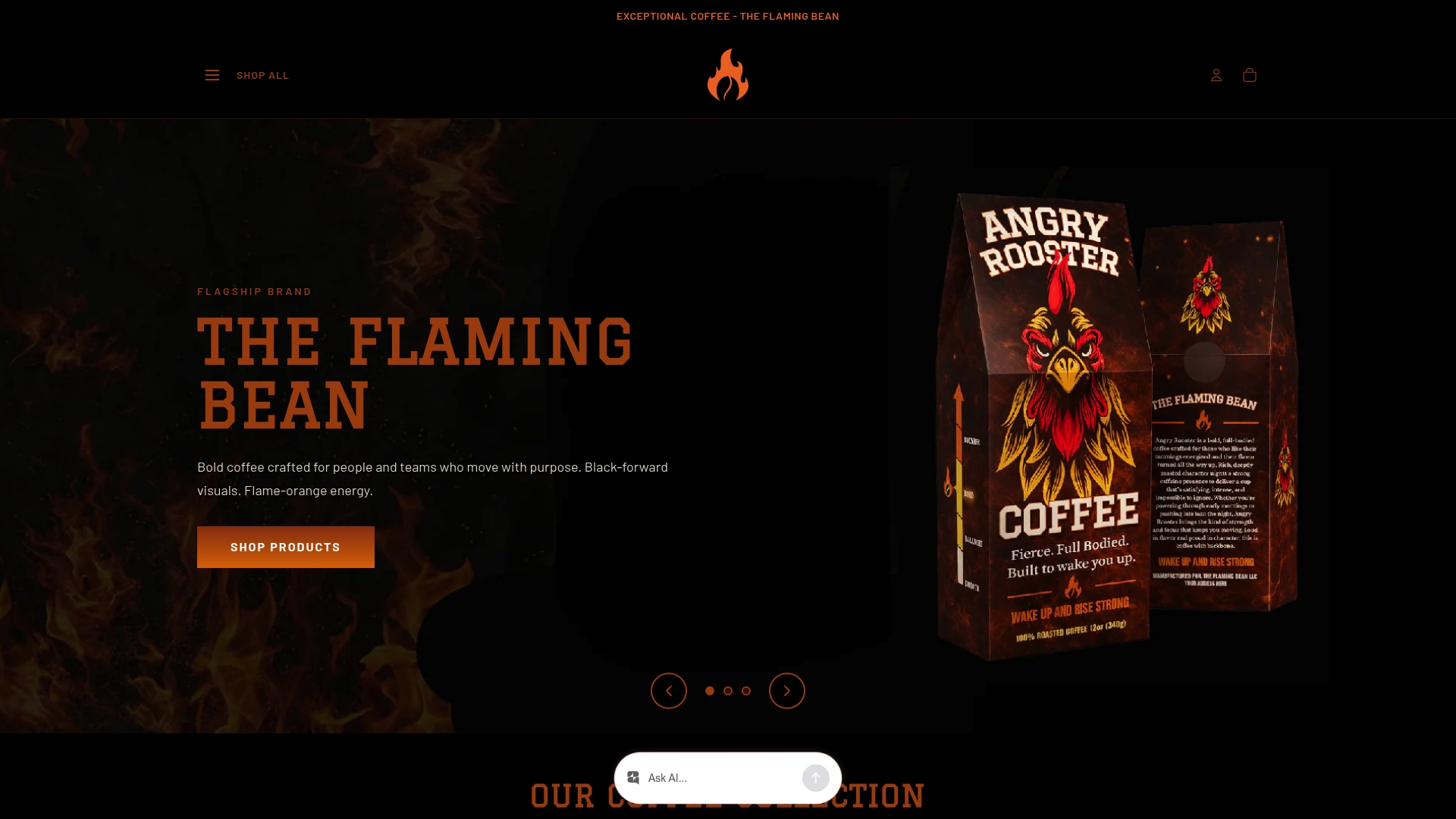
The Flaming Bean’s wholesale program is designed for coffee brands that take sourcing and quality seriously. From bold blends like Abyssal and Angry Rooster to smooth, approachable options like Evening Roast, every coffee in the lineup is roasted to highlight the character of the bean. If you are in the co-roasting phase and want to see what a fully realized roasting program looks like, The Flaming Bean’s catalog is a great place to start.
FAQ
What does co-roasting mean in simple terms?
Co-roasting means renting time on an established roastery’s equipment to produce coffee under your own brand, without owning a commercial roaster yourself.
Is co-roasting the same as white-label coffee?
No. White-label coffee means buying pre-roasted coffee and rebranding it. Co-roasting means you bring your own green beans and control the roast profile, producing a genuinely original product.
What volume makes co-roasting worth it?
Brands roasting under 110 lbs per month typically find co-roasting more cost-effective than purchasing and operating their own machine.
How is co-roasting different from co-fermentation?
Co-roasting is a post-origin business model involving shared roasting equipment. Co-fermentation is a farm-level processing technique where non-coffee ingredients are added during fermentation to shape the bean’s flavor before it ever reaches a roaster.
Can a co-roasted coffee still have a strong brand identity?
Yes. The coffee goes out in your packaging, under your name, with your story. Customers interact with your brand, not the facility where it was roasted.
Comments