
White Label vs. Private Label: A Small Brand Guide

Private label means you own the spec and no one else sells that exact product. White label means you’re putting your name on a pre-made formula the supplier sells to dozens of other brands. That single distinction drives every trade-off in cost, speed, and long-term defensibility.
Quick decision pointer: Choose white label if you need to launch fast, keep upfront costs low, and validate demand before committing. Choose private label when you have repeat-purchase data, want higher margins, and need a product competitors can’t copy.
| Dimension | White Label | Private Label |
|---|---|---|
| Exclusivity | Shared formula, multiple sellers | Yours alone |
| Customization | Branding only | Specs, ingredients, roast profile |
| Typical lead time | a few weeks | several weeks or more |
| Typical MOQ | low hundreds to around a thousand units | several hundreds to over a thousand units |
| Margin potential | Moderate | Higher |
Thomasnet’s breakdown of white label vs. private label explained this core distinction clearly: white label is a stock product sold to multiple brands; private label is made exclusively to your specification. The Flaming Bean’s Evening Roast and Safe Ground are examples of what private-label coffee looks like when it’s built around a brand’s specific identity and mission.
Key Takeaways
White label gets you to market fast with low commitment; private label builds a defensible brand with higher long-term margins, and the smartest path for most small brands is to start with white label and convert proven SKUs to private label once repeat-purchase data confirms demand.
| Point | Details |
|---|---|
| Core distinction | White label = shared formula, rebrand only; private label = exclusive spec, your brand alone. |
| Lead times and MOQs | White label runs 3–6 weeks at 100–1,000 units; private label takes 6–10+ weeks at 500–1,500+ units. |
| Margin advantage | Private-label products typically deliver higher gross margins than comparable white-label SKUs at scale. |
| Pilot-first approach | Run a 90-day white-label test before committing to a private-label MOQ — let sell-through data decide. |
| The Flaming Bean | Offers both white-label and private-label coffee programs, including Evening Roast and Safe Ground, with full COA and roast-date documentation. |
Table of Contents
- What is private label, and how does it actually work?
- What is white label, and how do you spot it?
- How do white label and private label compare side by side?
- What do MOQs, lead times, and costs actually mean for your margins?
- How do you choose a supplier and avoid costly mistakes?
- What does the white-label-to-private-label path look like in coffee?
- When does The Flaming Bean recommend white label vs. private label?
- The Flaming Bean’s private-label coffee program
- Sources
What is private label, and how does it actually work?
Private label is an exclusive product built to your specification and sold only under your brand. You define the formula, the roast profile, the ingredients, or the materials. The manufacturer produces it. Nobody else gets that exact SKU.
The relationship with a contract manufacturer typically starts with a brief: you describe what you want, the supplier proposes a base formula or process, and you iterate through samples until the product matches your standard. From there, you sign a contract that locks in the terms.
Common contractual elements include:
- Exclusivity clause: confirms the supplier won’t sell your formula to other buyers
- MOQ (minimum order quantity): the floor you must hit per run, usually 500–1,500+ units
- Payment terms: deposit on order, balance on shipment, or net-30 arrangements
- IP and recipe ownership: specifies who owns the formula if the relationship ends
- QC and recall responsibilities: defines who bears liability for defective product
The brand owns the trademark. The manufacturer owns the production capacity. That split matters legally: if your supplier goes under, you need the recipe and the right to take it elsewhere. Always negotiate IP ownership before signing.
Private labeling doesn’t require owning a factory. It’s a collaborative partnership where the manufacturer supplies production capacity and you supply the specifications and go-to-market plan. A coffee brand commissioning a specific single-origin roast profile is doing exactly this, as is a grocery chain that sells its own store-brand olive oil made by an established regional producer.
The Flaming Bean operates as a private-label partner for organizations and teams, with blends like Evening Roast and Safe Ground built around specific flavor goals and brand missions. Those products exist because a brand decided what it wanted and committed to a run. That’s private label explained in practice.
Pro Tip: Before signing any private-label agreement, ask the supplier directly: “If we part ways, who owns the formula?” If the answer is vague, add an explicit IP-assignment clause before you commit.
What is white label, and how do you spot it?
White label is a pre-made, vendor-owned formulation that the supplier sells to multiple brands. You apply your logo and packaging. The product underneath is identical to what a dozen other companies are selling under their own names.
The supplier flow is straightforward. The manufacturer develops a stock SKU, earns certifications and a Certificate of Analysis (COA) for it, and then offers it to any buyer who meets the MOQ. Lead times are short because the product already exists. You’re essentially buying inventory and branding rights, not commissioning a new product.
Who carries regulatory and QA responsibility is a common point of confusion. The supplier holds the COA and the underlying certifications. But your brand is on the label, so you are responsible for the marketing claims you make. If you say “premium single-origin” on a white-label bag of blended commodity coffee, that’s your liability, not the supplier’s.
White-label products are common across electronics, software, consumer goods, and food and beverage. A private-label supplement brand and a white-label supplement brand can be sourcing from the same facility and the same base formula. The difference is whether you negotiated exclusivity and spec changes — or just ordered and rebranded.
Short examples of white-label usage: a startup launching a house-brand protein powder using a manufacturer’s stock formula; a regional retailer selling a store-brand coffee using a roaster’s standard medium roast SKU; a SaaS company reselling a platform under its own name.
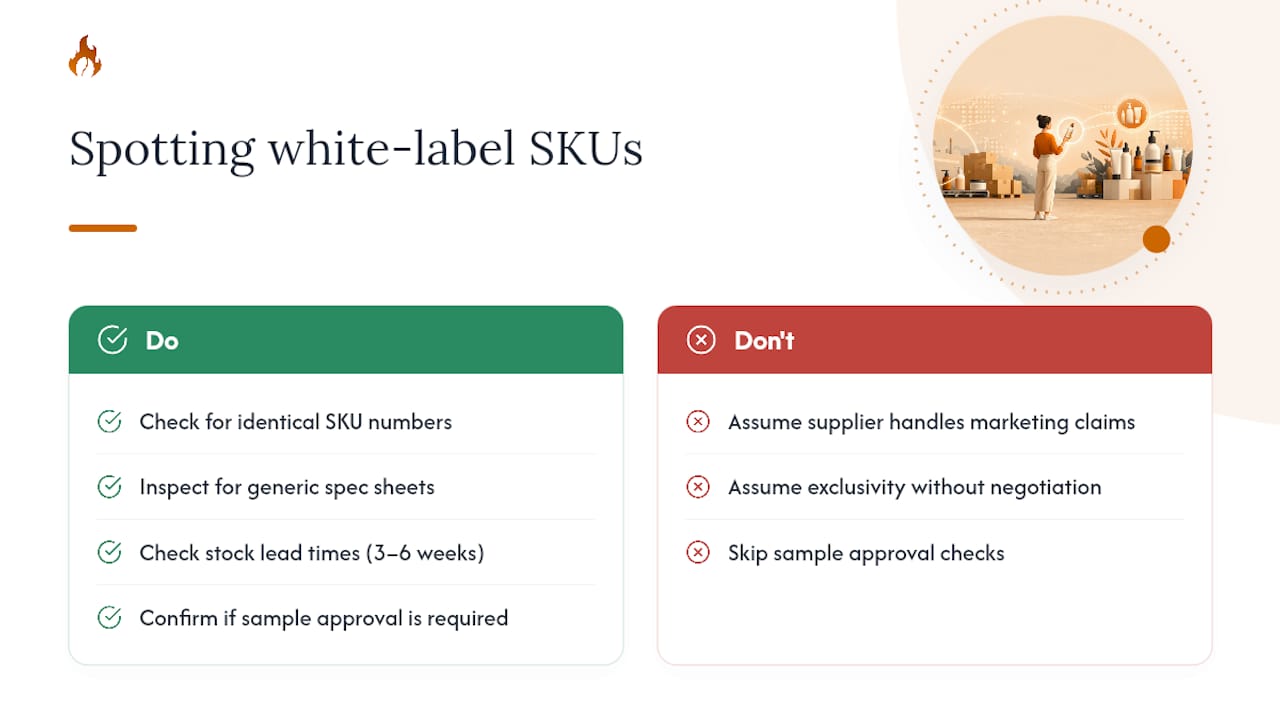
Pro Tip: Spotting a white-label SKU in a supplier quote is straightforward. Look for identical SKU numbers across their catalog, generic spec sheets with no brand-specific parameters, and stock lead times of 3–6 weeks. If the supplier can ship in three weeks with no sample approval process, you’re almost certainly looking at white label.
How do white label and private label compare side by side?
According to The Very Lab’s sourcing guide, white-label sourcing runs roughly 3–6 weeks with MOQs around 100–1,000 units, while private label typically requires 6–10+ weeks and MOQs of 500–1,500+. Those numbers shape everything below.
| Dimension | White Label | Private Label |
|---|---|---|
| Exclusivity | None — same formula, multiple sellers | Full — your spec, your brand only |
| Customization | Label and packaging only | Ingredients, specs, roast profile, format |
| Speed to market | 3–6 weeks | 6–10+ weeks |
| MOQ | 100–1,000 units | 500–1,500+ units |
| Upfront cost | Low | Moderate to high |
| Per-unit cost | Moderate | Lower at scale |
| Gross margin potential | Moderate | Higher |
| QA/regulatory control | Supplier holds COA; brand owns claims | Brand owns full QA responsibility |
| Supplier dependence | High — formula is theirs | Moderate — formula is yours if IP is assigned |
| Marketplace defensibility | Low — hijacking risk on Amazon | Higher with meaningful spec changes |
| Best for | Fast launch, demand testing, breadth | Hero SKUs, brand differentiation, scale |
A few quick takeaways from that comparison:
- White label wins on speed and low commitment. It’s the right call when you don’t yet know which SKU will sell.
- Private label benefits include materially higher gross margins and a product competitors can’t replicate.
- On marketplaces like Amazon, white-label SKUs carry real hijacking risk because identical formulas exist across multiple sellers. Private label with meaningful spec changes is more defensible.
- The margin gap between the two models tends to widen at scale, which is why growing brands convert their best white-label performers into private-label runs.
What do MOQs, lead times, and costs actually mean for your margins?
White label typically offers shorter lead times and lower minimum order quantities than private label, which tends to involve longer lead times and higher minimum orders. Those are the sourcing ranges The Very Lab documents for each model.
Here’s what those numbers mean in practice:
Scenario A — White label coffee, 500 units at a moderate price per unit: Total landed cost: $3,000. Fast to market, low commitment, but the supplier can sell the same product to your competitor tomorrow.
Scenario B — Private label coffee, 1,000 units at a somewhat lower per-unit cost due to higher order quantity: Total landed cost: $5,000. Higher upfront, but Shopify’s private-label analysis confirms private-label products often deliver significantly higher gross margins than standardized white-label SKUs.
The math favors private label at scale. The risk favors white label early.
Pro Tip: Before committing to a private-label MOQ, run a white-label pilot for 90 days. If repeat purchase rate is strong and you’re selling through inventory, that’s your signal to convert. Don’t commit to 1,000 units of a private-label formula until you’ve sold 300 units of the white-label equivalent.
How do you choose a supplier and avoid costly mistakes?
Pick white label for early tests and breadth. Pick private label for hero SKUs and defensibility. That’s the rule. Here’s how to execute it.
Sourcing checklist (run this for every supplier you evaluate):
- Define the SKU’s role — is this a test product or a brand-defining hero?
- Request the COA and a sample batch before any commitment
- Verify certifications match your market’s requirements (FDA registration, organic, fair trade, etc.)
- Get MOQ and lead-time quotes in writing, including rush-order pricing
- Require a written exclusivity clause if you’re going private label
- Ask about change control: what happens if the supplier changes the formula or a raw material?
- Confirm production capacity: can they scale with you if demand doubles?
Questions to ask every supplier:
- Do you offer pricing tiers at higher volumes, and what are the breakpoints?
- Are there tooling or setup costs for custom packaging or formulations?
- What certifications does this SKU currently hold?
- What’s your recall history, and how do you handle defective batches?
- Can I see the batch number from the last production run?
Red flags to walk away from:
- Evasive or inconsistent answers about COA documentation
- Refusal to share sample batch numbers
- MOQ explanations that shift between conversations
- Unwillingness to sign any exclusivity language for a private-label run
- No clear answer on who owns the formula if the relationship ends
Private Label Supply recommends getting three quotes for every product: one white-label, one stock-base private label, and one fully custom private label. Comparing all three reveals the true economics and shows you exactly where the exclusivity premium sits.
Mini-pilot plan:
- Order a small white-label run (100–300 units) and sell it over 60–90 days
- Track repeat purchase rate and customer feedback on the product
- Convert your top-selling SKU to a private-label run once repeat metrics are strong
This staged approach is how most physical-goods brands scale without overcommitting capital early. The same principle applies in jewelry, supplements, and coffee alike. For a broader look at how private-label mechanics work across categories, JewelCloud’s private-label manufacturing guide shows how the same exclusivity and spec-ownership questions play out in a completely different product category.
What does the white-label-to-private-label path look like in coffee?
In coffee, the transition from white label to private label is one of the most common growth patterns in the category. Brands start with a stock roast to test market fit then commission exclusive blends once they have repeat-purchase data. That’s the pattern Thomasnet’s sourcing guide documents across physical-goods categories.
A representative journey looks like this: a small ecommerce brand sources a white-label medium roast, sells it under their name for three months, and discovers their customers keep reordering and leaving comments about wanting something smoother for evenings. That feedback is the brief for a private-label run. They go back to their roaster with a specific request: a lower-acidity, medium-dark roast with tasting notes that fit a wind-down occasion. That’s how a product like Evening Roast comes to life.
Practical tips specific to coffee private label:
- Roast-date labeling: always require a roast date on the bag, not just a best-by date. Customers notice, and it signals freshness.
- Origin claims: if you want to say “single-origin Ethiopia,” your COA and supplier contract must confirm that origin. Don’t claim it on a blended SKU.
- Storage and shelf life: whole bean holds quality longer than pre-ground. Clarify packaging format (valve bag, nitrogen flush) before finalizing specs.
- Sample cupping: request a cupped sample from the actual production batch before approving a run, not just a pre-production prototype.
- COA expectations: a credible coffee private-label partner provides moisture content, water activity, and country-of-origin documentation.
Mission-driven private-label coffee adds another layer. The Flaming Bean’s Safe Ground blend is built around a charitable purpose, which means the brand story is part of the product spec. That’s a legitimate differentiator a white-label SKU can’t replicate, because the mission is exclusive to the brand that commissioned it.
Don’t claim proprietary blends you didn’t commission. If a supplier offers you a “signature blend” that’s actually their stock SKU with your label, marketing it as a proprietary recipe is a compliance problem. Your label, your responsibility.
Pro Tip: Ask your coffee roaster for the custom branding examples they’ve produced for other clients. A roaster with a real private-label program will have packaging samples, COA templates, and a defined sample-approval process ready to show you.
When does The Flaming Bean recommend white label vs. private label?
The brands that get this decision right share one habit: they let sales data make the call, not enthusiasm.
Early-stage brands with unvalidated SKUs almost always benefit from white label first. The lower MOQ and shorter lead time mean you’re risking weeks and hundreds of dollars, not months and thousands. Once you have 90 days of sell-through data and a repeat purchase rate that tells you customers are coming back, you have the brief for a private-label run. At that point, the higher MOQ is a feature, not a risk, because you know the demand exists.
The actionable version: if you lack validated demand, buy white label for 3–6 months. Convert your top one or two SKUs to private label once repeat-purchase metrics are consistently strong. McKinsey’s analysis of private-label strategy makes clear that private-label success requires more than a good product spec. It needs an assortment strategy, a go-to-market plan, and organizational alignment to realize margin gains at scale. Jumping to private label before you have those elements in place is how brands end up with 1,000 units of a product that doesn’t move.
The Flaming Bean’s private-label coffee program
The Flaming Bean offers both white-label SKUs for fast launches and full private-label coffee runs for brands ready to own their roast profile. That includes packaging with roast-date labeling, origin documentation, and sample-approval cupping before any production run ships.
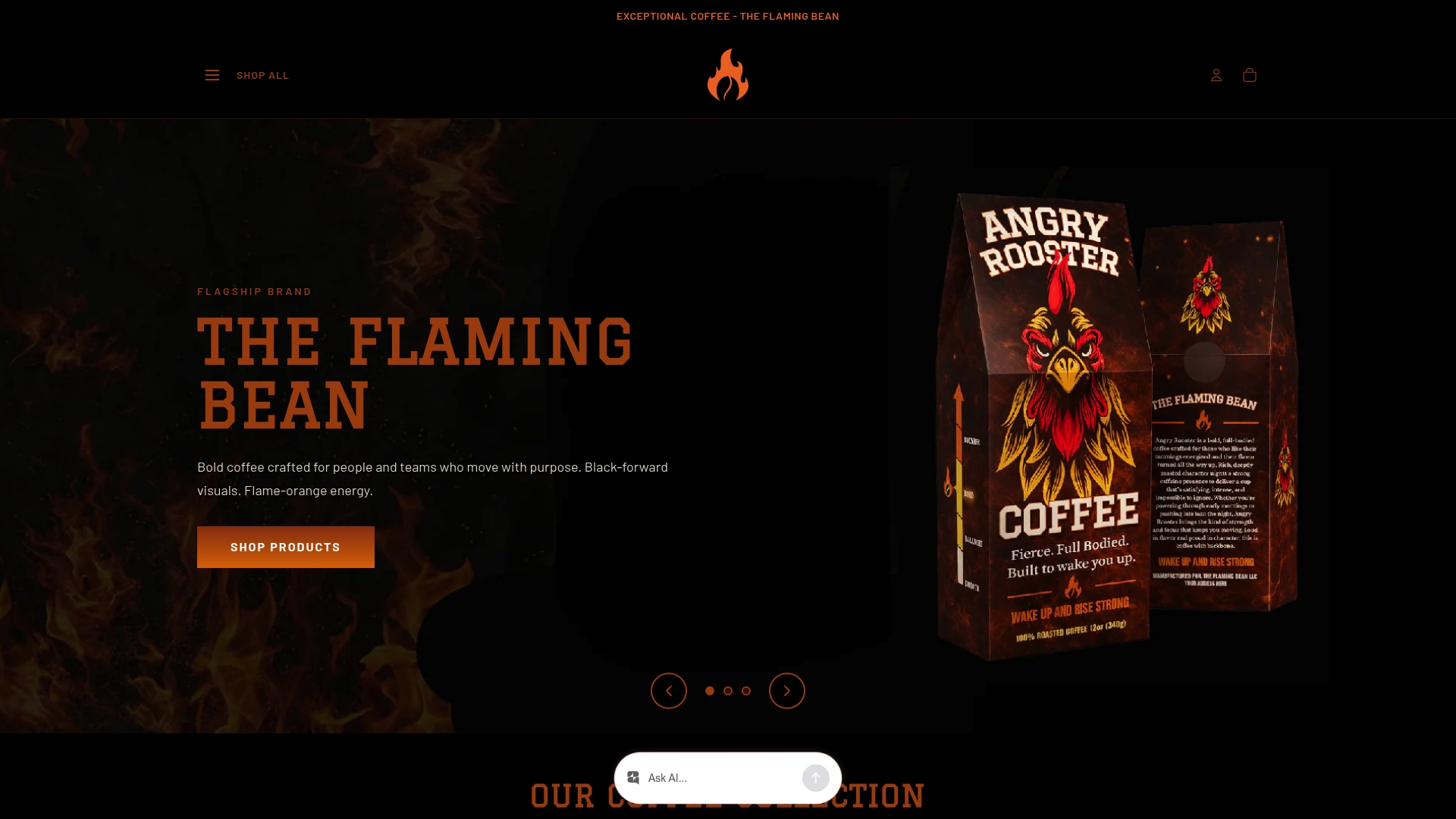
If you’re testing demand, a white-label run through The Flaming Bean gets you to market in weeks. If you’re ready to build a hero SKU, the private-label program covers everything from roast-profile development to mission-driven blends like Safe Ground and smooth, approachable options like Evening Roast. Other sourcing routes exist, and we encourage you to use the checklist in this article to evaluate any supplier you consider. When you’re ready to talk specifics, visit The Flaming Bean’s wholesale page to request a quote.
Sources
- White label vs private label: what’s the difference? | Thomasnet
- White label vs private label vs contract manufacturing — The Very Lab
- What is private label? — Shopify
- Private label vs white label — Private Label Supply
Recommended
- How to Choose a White Label Coffee Roaster in 2026 – The Flaming Bean Roastery
- How to Differentiate Your Private Label Coffee Brand – The Flaming Bean Roastery
- Design Coffee Brand Packaging: A Roaster’s 2026 Guide – The Flaming Bean Roastery
- Examples of Custom Coffee Branding for Entrepreneurs – The Flaming Bean Roastery
Comments