
Why Coffee Causes Jitters: Science-Backed Fixes

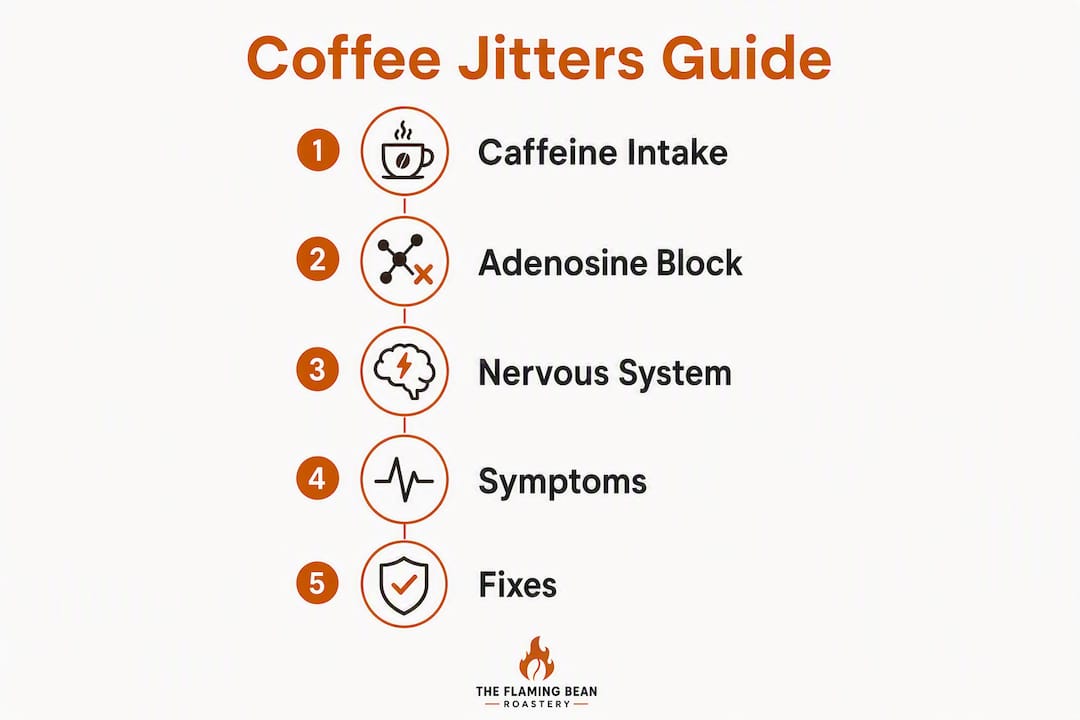
Coffee causes jitters because caffeine blocks adenosine receptors in your brain, removing the natural “brake” on neural activity. With that brake gone, dopamine and norepinephrine surge, your HPA axis fires up, and adrenaline and cortisol flood your system. The result: a racing heart, shaky hands, and that wired-but-anxious feeling you know too well. If you’re feeling it right now, stop drinking caffeine immediately and drink a full glass of water with a small snack that has both protein and carbohydrates. That combination helps blunt the blood-sugar swings that make jitters worse. And if you’re experiencing chest pain or fainting, skip the home remedies and call emergency services.
A nationwide survey found that about 36% of American coffee drinkers report experiencing jitters or similar sensitivity symptoms, with adults aged 18–24 reporting the highest rates. So if this happens to you regularly, you’re far from alone.
Table of Contents
- What do coffee jitters actually feel like?
- Why does caffeine make you jittery? The actual mechanism
- Who is more likely to get jitters from coffee?
- How much caffeine triggers jitters, and how long do they last?
- How to stop coffee jitters right now
- How to prevent jitters before they start
- Drugs and substances that change how caffeine hits you
- When should you see a doctor about coffee jitters?
- What recent research says about caffeine sensitivity
- Key Takeaways
- The coffee ritual is worth protecting
- Lower-jitter coffee options from The Flaming Bean
- Useful sources and further reading
What do coffee jitters actually feel like?
Most people recognize the obvious signs, but jitters show up in more ways than just shaky hands. Knowing the full picture helps you tell the difference between a normal stimulant response and something worth paying closer attention to.
Common symptoms include:
- Shakiness or tremor in the hands or legs
- Racing heart or palpitations (a fluttering or pounding sensation in the chest)
- Nervous energy that feels hard to channel or sit with
- Difficulty concentrating, even though you drank coffee to focus
- Dizziness or lightheadedness
- Nausea, especially on an empty stomach
- Sweating beyond what the temperature warrants
- Restlessness and an inability to stay still
Symptoms typically start 15–45 minutes after intake, peak somewhere around 30–90 minutes, and can linger for several hours in people who metabolize caffeine slowly. Intensity varies a lot. One person might feel mildly buzzed; another might feel like they’re vibrating.
The key distinction is between a normal stimulant effect and a sensitivity response. A normal response feels energizing and manageable. A sensitivity response feels unpleasant, intrusive, and hard to shake.
Pro Tip: If you notice persistent palpitations, chest discomfort, or a racing heart that doesn’t settle within an hour or two, that’s not typical jitter territory. Those symptoms warrant a conversation with your doctor, not another cup of water.
Why does caffeine make you jittery? The actual mechanism
Caffeine is a methylxanthine-class central nervous system stimulant and the most widely consumed psychoactive substance in the world. Its primary mechanism is straightforward: it blocks adenosine receptors, specifically A1 and A2A receptors in the brain.

Adenosine is a neurotransmitter that builds up throughout the day and makes you feel progressively sleepier. When caffeine occupies those receptors, adenosine can’t bind. The neural “brake” lifts. Suddenly, neurons fire more freely, and the brain interprets this as a state of heightened alertness.
That’s where the downstream cascade begins. Increased neural firing drives up dopamine and norepinephrine, the neurotransmitters behind motivation, focus, and arousal. Norepinephrine also constricts blood vessels and raises heart rate. Simultaneously, the HPA axis (the hypothalamic-pituitary-adrenal axis) activates, releasing adrenaline and cortisol. Those are your classic stress hormones. Your body is now in a mild fight-or-flight state, which is precisely what a racing heart, trembling hands, and anxious energy feel like from the inside.
Caffeine doesn’t create energy out of nowhere. It borrows against your adenosine reserves and triggers a stress-hormone response your nervous system reads as urgency. The bigger the dose, the louder that signal.
Timing and dose amplify everything. Caffeine reaches peak plasma concentration within about an hour after ingestion. A small dose produces a manageable lift; a large dose floods more receptors simultaneously, producing a proportionally stronger catecholamine and cortisol surge. That’s why two espresso shots feel fine and four feel like a panic attack.
Who is more likely to get jitters from coffee?
Not everyone reacts the same way to the same cup. Caffeine response exists on a population continuum from slow to rapid metabolizers, and where you fall on that spectrum is largely genetic.

Genetics: CYP1A2 and ADORA2A
The CYP1A2 gene controls how quickly your liver breaks down caffeine. Slow metabolizers carry a variant that keeps caffeine circulating in their bloodstream far longer, which means stronger and longer-lasting effects at the same dose a fast metabolizer handles easily. The ADORA2A gene, which codes for adenosine A2A receptors, also plays a role. Certain variants make those receptors more sensitive to blockade, increasing the anxiety and jitter response even at moderate doses.
Non-genetic factors that raise your risk
Several factors can push even a normally tolerant person into jitter territory:
- Sleep deprivation raises baseline cortisol and adrenaline, so caffeine’s stress-hormone effect stacks on top of an already elevated level
- Existing anxiety or panic disorder makes the adrenergic surge feel much more intense and can increase the likelihood of panic attacks
- Pregnancy slows caffeine metabolism significantly, extending its effects
- Age matters more than most people expect: adults aged 65–70 metabolize caffeine about 33% slower than younger adults, which means a cup that felt fine at 40 can feel overwhelming at 65
- Medications that inhibit CYP1A2 (discussed in a later section) slow clearance and amplify effects
- Hormonal shifts, including the menstrual cycle and menopause, can temporarily alter sensitivity
The 36% prevalence figure from the nationwide survey reflects just how common these overlapping factors are. Sensitivity isn’t a personal failing. It’s biology.
How much caffeine triggers jitters, and how long do they last?
Up to 400 mg of caffeine per day is generally considered safe for most healthy adults, according to clinical guidance. But that number is an average threshold, not a personal guarantee. Slow metabolizers can experience jitters well below that level.
| Source | Approximate Caffeine (mg) |
|---|---|
| 8 oz black tea | 30–50 mg |
For most people, jitters kick in when intake exceeds their personal threshold in a short window, often two or three cups consumed quickly rather than spread across the day. Onset typically runs 15–45 minutes after drinking. Peak effects arrive around 30–90 minutes in. For fast metabolizers, the whole episode resolves within three to four hours. For slow metabolizers, caffeine’s half-life can stretch considerably longer, meaning symptoms can persist well into the afternoon from a morning cup.
Age compounds this. The 33% slower metabolism seen in adults aged 65–70 means a two-cup morning routine that felt fine for decades can start producing afternoon jitters as metabolism naturally slows.
How to stop coffee jitters right now
If you’re already jittery, here’s what actually helps. Work through these steps in order.
- Stop all caffeine immediately. No more coffee, tea, energy drinks, or soda. Adding more caffeine to manage the feeling doesn’t work.
- Drink water. Caffeine is a mild diuretic, and dehydration intensifies the jittery sensation. Aim for at least 8–12 oz right away.
- Eat a balanced snack. Pair a complex carbohydrate (a slice of whole-grain bread, a banana) with a protein source (nut butter, cheese, a hard-boiled egg). This blunts blood-sugar swings that amplify the adrenergic response.
- Practice paced breathing. Try a 4-4-8 pattern: inhale for 4 counts, hold for 4, exhale slowly for 8. The extended exhale activates the parasympathetic nervous system and directly counters the fight-or-flight state caffeine triggered. Repeat for 5–10 cycles.
- Take a short walk. Light movement burns off excess adrenaline and norepinephrine. A 10-minute walk at a comfortable pace is enough to take the edge off without spiking your heart rate further.
Pro Tip: Avoid reaching for alcohol to “calm down” from jitters. Alcohol and caffeine interact unpredictably, and the combination can mask how impaired or overstimulated you actually are. The same goes for energy drinks marketed as “calming” — many still contain stimulants.
How to prevent jitters before they start
Prevention is simpler than most people think, and it rarely means giving up coffee entirely.
- Lower your dose gradually. If you regularly drink three or four cups, drop to two for a week before reassessing. Abrupt cuts trigger caffeine withdrawal symptoms like headaches and irritability that are easy to confuse with ongoing sensitivity. A gradual taper using mixed brews (part regular, part decaf) preserves the ritual and limits withdrawal.
- Always eat before or with your coffee. Drinking on an empty stomach speeds caffeine absorption and amplifies the cortisol spike. A small meal changes the absorption curve meaningfully.
- Time your intake carefully. Caffeine consumed within six hours of bedtime disrupts sleep, and poor sleep raises baseline stress hormones, making the next morning’s cup hit harder. Cutting off caffeine by early afternoon is a practical starting point for most people.
- Choose lower-caffeine options for afternoon cups. Dark roasts are often assumed to be stronger, but the roasting process actually reduces caffeine slightly compared to lighter roasts. Switching to a lower-caffeine blend or a half-caf option for your second or third cup is an easy adjustment. If you want to compare caffeine levels across beverages, chai offers a gentler caffeine curve than most brewed coffee.
- Consider decaf for evening ritual. Decaf retains the flavor, the warmth, and the social ritual of coffee with a fraction of the caffeine. It’s not a compromise; it’s a practical tool.
- Space your cups. Two cups back-to-back hit your receptors simultaneously. Two cups spread two hours apart give your system time to process the first dose before the second arrives.
Pro Tip: If you want to explore lower-caffeine blends without sacrificing flavor, look for roasts specifically designed for smooth, approachable profiles. The Flaming Bean’s specialty blends collection includes options built for exactly that kind of balance.
Drugs and substances that change how caffeine hits you
Caffeine doesn’t metabolize in isolation. Several common medications and substances either slow its clearance or amplify its stimulant effects, sometimes dramatically.
Substances that slow caffeine metabolism (raising blood levels and extending effects):
- Oral contraceptives inhibit CYP1A2 and can roughly double caffeine’s half-life in some individuals
- Certain antibiotics, particularly fluoroquinolones like ciprofloxacin, compete for the same metabolic pathway
- Some SSRIs and antidepressants, including fluvoxamine, are among the strongest CYP1A2 inhibitors known
- Herbal supplements such as echinacea and certain flavonoids can also slow clearance, though effects vary
Substances that stack stimulant effects:
- Energy drinks combined with coffee add caffeine on top of caffeine, plus other stimulants like taurine and B vitamins that can compound the adrenergic response
- Nicotine works differently: smoking actually accelerates caffeine clearance, which means smokers who quit often find their existing coffee habit suddenly feels much stronger
If you’ve recently started or stopped a medication and your usual coffee routine suddenly feels overwhelming, that’s not a coincidence. CYP1A2 inhibitors can turn a previously comfortable dose into one that produces significant jitter symptoms. Talk to your pharmacist before adjusting your caffeine intake around a new prescription.
The interaction picture is worth discussing with a clinician or pharmacist, especially when starting or stopping medications that affect liver enzymes. This is general information, not medical advice; confirm specifics with a qualified healthcare provider.
When should you see a doctor about coffee jitters?
Most jitter episodes resolve on their own within a few hours. Some symptoms, though, signal something beyond routine caffeine sensitivity.
Seek emergency care immediately for:
- Chest pain or pressure
- Fainting or near-fainting (syncope)
- Difficulty breathing
- Severe or prolonged palpitations that don’t settle after stopping caffeine
Schedule a non-emergency appointment with your doctor if:
- Palpitations or racing heart persist despite reducing or eliminating caffeine
- You experience jitters at doses well below the 400 mg/day threshold
- Symptoms are worsening over time without a clear change in intake
- You have a known anxiety disorder and caffeine is making it significantly harder to manage
Clinical guidance recommends keeping a short intake diary: log what you drank, how much, and when symptoms appeared. Bring that log to your appointment. It gives your clinician a concrete picture instead of a vague complaint, and it makes the conversation much more productive.
What recent research says about caffeine sensitivity
The science on caffeine sensitivity has sharpened considerably in recent years, moving away from a simple “sensitive vs. not sensitive” binary toward a more nuanced model.
| Finding | Key Detail | Source |
|---|---|---|
| Population prevalence | 36% of American coffee drinkers report jitters or sensitivity symptoms; highest in ages 18–24 | USA Today / Everyday Dose survey |
| Metabolism continuum | Caffeine response is a spectrum from slow to rapid metabolizers, not a binary | 2026 pharmacology overview |
| Age-related slowdown | Adults 65–70 metabolize caffeine 33% slower than younger adults | UCLA Health |
| Anxiety amplification | Caffeine can worsen pre-existing anxiety and raise panic attack likelihood in susceptible individuals | Clinical review |
The 2026 pharmacology perspective is particularly useful for understanding why two people can drink the same cup and have completely different experiences. Genetics, age, medications, sleep, and stress all shift where someone sits on that metabolism continuum on any given day. Sensitivity isn’t fixed; it fluctuates.
36% of American coffee drinkers report jitters or sensitivity symptoms — making it one of the most common side effects of the country’s most popular beverage.
Key Takeaways
Caffeine causes jitters by blocking adenosine receptors, triggering a stress-hormone surge that produces racing heart, shakiness, and anxiety, with genetics and lifestyle factors determining how strongly any individual responds.
| Point | Details |
|---|---|
| Core mechanism | Caffeine blocks adenosine receptors, raising dopamine, norepinephrine, adrenaline, and cortisol. |
| Immediate relief | Stop caffeine, hydrate, eat a protein-carb snack, and practice 4-4-8 paced breathing. |
| Dose threshold | Up to 400 mg/day is the general adult guideline, but slow metabolizers react at lower doses. |
| When to get help | Chest pain, fainting, or persistent palpitations need medical attention, not home remedies. |
| Lower-jitter options | The Flaming Bean’s Evening Roast and Safe Ground offer lower-stimulant alternatives for sensitive drinkers. |
The coffee ritual is worth protecting
Here’s what I think gets lost in most conversations about coffee jitters: the goal isn’t to quit coffee. It’s to understand your own relationship with it well enough to keep it working for you.
The science is clear that caffeine sensitivity is biological, not a weakness. Genetics, age, sleep, stress, and medications all shift how your body handles the same cup. What worked at 30 might not work at 50. What’s fine on a rested Tuesday might be too much on a sleep-deprived Friday. That variability is normal, and it’s worth paying attention to rather than pushing through.
What I find most useful about the metabolism-continuum model is that it reframes the question. Instead of “am I sensitive to caffeine?” the better question is “where am I on the spectrum today, given everything else going on?” That shift makes it easier to make practical adjustments, whether that’s switching to a lighter roast, cutting off caffeine earlier in the day, or choosing a lower-caffeine blend for your afternoon cup, without feeling like you’re giving something up.
We think about this a lot at The Flaming Bean. Great coffee should feel good. If it doesn’t, that’s information, not failure. Tracking your intake, paying attention to timing, and choosing roasts that match your current tolerance are all part of being a thoughtful coffee drinker. That’s something worth celebrating, not apologizing for.
Lower-jitter coffee options from The Flaming Bean
If jitters have been getting in the way of enjoying your daily cup, we have options built for exactly that situation. Safe Ground is one of our purpose-driven blends with a lower-stimulant profile, designed for drinkers who want the ritual and the flavor without the adrenergic spike. Every bag also supports organizations working to protect vulnerable individuals, so your cup does double duty.
Evening Roast is crafted for later in the day, when you want something warm and satisfying without disrupting your sleep or stacking caffeine on top of an already elevated stress level. Smooth, approachable, and genuinely good.
Both fit the prevention strategies covered in this article: lower dose, better timing, and flavor that doesn’t ask you to compromise. Browse the full signature blends collection to find the right fit for your tolerance and your routine.
Useful sources and further reading
The claims in this article draw from clinical, academic, and journalistic sources. Here’s a quick reference for readers who want to go deeper.
| Source | What it covers |
|---|---|
| Cleveland Clinic: Caffeine Sensitivity | Clinical symptoms, 400 mg/day guideline, diary-keeping advice, and treatment options |
| MedlinePlus: Caffeine | Standard clinical overview of caffeine effects, excess intake symptoms, and diuretic properties |
| Time: Why Coffee Causes Anxiety | Adenosine receptor blockade mechanism, HPA-axis activation, and stress-state amplification |
| USA Today: Coffee Jitters Survey | Nationwide survey data on jitter prevalence and age-group differences |
| Springer: Caffeine Metabolism Pharmacology | 2026 pharmacology overview of the metabolism continuum and inter-person variability |
| UCLA Health: Caffeine and Aging | Age-related metabolic slowdown and its practical implications |
| NCBI StatPearls: Caffeine | Comprehensive pharmacology reference for caffeine as a methylxanthine stimulant |
| PMC: Caffeine and Neurotransmitter Systems | Peer-reviewed research on adenosine A1/A2A receptor antagonism and catecholamine release |
For personalized guidance on caffeine sensitivity, especially if you take medications or have a pre-existing condition, consult a licensed healthcare provider. This article is general information only.
Recommended
- Why Coffee Brings People Together – The Flaming Bean Roastery
- Why Gyms Sell Branded Coffee: Performance, Profit, and Community – The Flaming Bean Roastery
- Why Some Coffee Tastes Chocolatey: A Flavor Guide – The Flaming Bean Roastery
- What Is a Cause Coffee Brand? Your Complete Guide – The Flaming Bean Roastery
Comments